
The Container Development Model - Peter Garrett
I recall starting a new job when I was in my late 30s. I had been running my own business importing women’s fashion clothing into the UK and wholesaling it to upmarket independent women’s dress shops from a fancy display unit in the rag trade area, behind Oxford Street in London. Then the supply end in South Africa failed to deliver. As I was closing things down and letting the showroom, I thought how much I would enjoy working with property. An old friend was now running the property development side of his family’s business, and an opportunity opened up for me to join him. I did not have much experience, so I prepared carefully for my interview with his uncle, the founder of the much-larger conglomerate of construction businesses. I related to him how I had purchased and developed a residential property (which happened to be my own home) some years previously to get myself out of debt. The story was impressive enough for him, and I was hired at a good salary.
I accept these papers are made available to me privately as a Member of the Academy and I understand that until these are published, I must have the author's permission to circulate or use their paper.
These papers have now been published in The World Needs Dialogue! Three: Shaping the Profession
© Peter Garrett, 2021
The World Needs Dialogue!
Three: Shaping the Profession
ISBN: 978-1916191273

I recall starting a new job when I was in my late 30s. I had been running my own business importing women’s fashion clothing into the UK and wholesaling it to upmarket independent women’s dress shops from a fancy display unit in the rag trade area, behind Oxford Street in London. Then the supply end in South Africa failed to deliver. As I was closing things down and letting the showroom, I thought how much I would enjoy working with property. An old friend was now running the property development side of his family’s business, and an opportunity opened up for me to join him. I did not have much experience, so I prepared carefully for my interview with his uncle, the founder of the much-larger conglomerate of construction businesses. I related to him how I had purchased and developed a residential property (which happened to be my own home) some years previously to get myself out of debt. The story was impressive enough for him, and I was hired at a good salary.
The property development company had a total staff of nine, including the partners and the clerical support staff, and was housed in a prestigious and delightfully ornate four-story brick building in South Audley Street, Mayfair. This is just one block away from Park Lane; if you have played the English version of Monopoly you will know this is an expensive area. I had a well-appointed office, and an experienced personal assistant called Thelma. This was back in the days when executives used Dictaphones and their PAs typed their letters for signature or amendment. The whole environment was different and new to me. I didn’t really know how things worked in property development, and I knew that I didn’t know. I feigned a confident and relaxed air whilst watching everything going on around me very carefully for all the clues I could get. It took me nearly an hour to work out how to use the Dictaphone! This was a highly professional business that made good profits developing commercial and residential property across the UK. They had a dozen or more large and active developments under way at any time, and expected to sell a number of properties every month. The best architects, solicitors and estate agents were keen to have our business.
The role I was expected to play was explained to me on my first day. My brief was to clean up a mixed portfolio of dormant parcels of land that had at some point in the previous 30 years been reserved for later development, thought worthless or simply forgotten. I would have to search in the hard-copy paper archives for evidence we actually had the title to the various pieces of land, then use my initiative to turn them into profitable developments. In addition I was given two active sites. I was learning fast – largely learning that there were yet further areas of the business about which I knew next to nothing!
On my second day at work I found myself attending a meeting in a barrister’s chambers, since I was now a Project Development Manager and this was a key meeting for my active site in the south-coast port of Dover. We held an option to buy development land there pending the gaining of planning permission. Our planning application had been refused, and so we were taking the application to appeal with the Department of the Environment who could, in certain circumstances, overrule the County Council’s planning decision. I had to instruct the barrister on how to proceed with our case. Clearly I was naïve in the matter and almost out of my depth. The stakes were high and mistakes could be very costly. I was accompanied by one of our solicitors, whom I met as we entered the chambers, and then it dawned on me what to do. I delegated the briefing of the barrister to him. That way my own inexperience was less obvious as I started to understand the situation and what was involved. They knew I had been recently appointed into my role, and attributed more experience to me than I felt I had.
Over the following months I came to understand the situation more clearly and took on the briefings of the barrister myself. My inexperienced but creative thought and challenges helped to define the arguments that led to us gaining planning permission for an out-oftown retail shopping park in Dover. It was a significant success and I was starting to show up as a confident and competent player. I negotiated the purchase of several further tranches of land from a neighbouring farmer, to our mutual benefit. Then I worked with the architects on the extensive development, tendered the building contracts, project-managed the construction work, let the completed units to top supermarkets, DIY retailers and so on. I completed the process by selling the properties to a pension fund with sitting tenants, yielding a steady income for the new owners. By this time I was the real thing – an experienced Property Development Manager. My main portfolio of forgotten tracts of land had become valuable sites that realised good income: much sought-after car parking in a congested town; a ransom strip (similar to an easement) that provided access to a large residential development near London; a golf course; a cemetery; a cluster of combined live-and-work units for new start-up businesses in Yorkshire, among others. I had found a way of doing things that was effective, and I enjoyed the work.
Inner Development
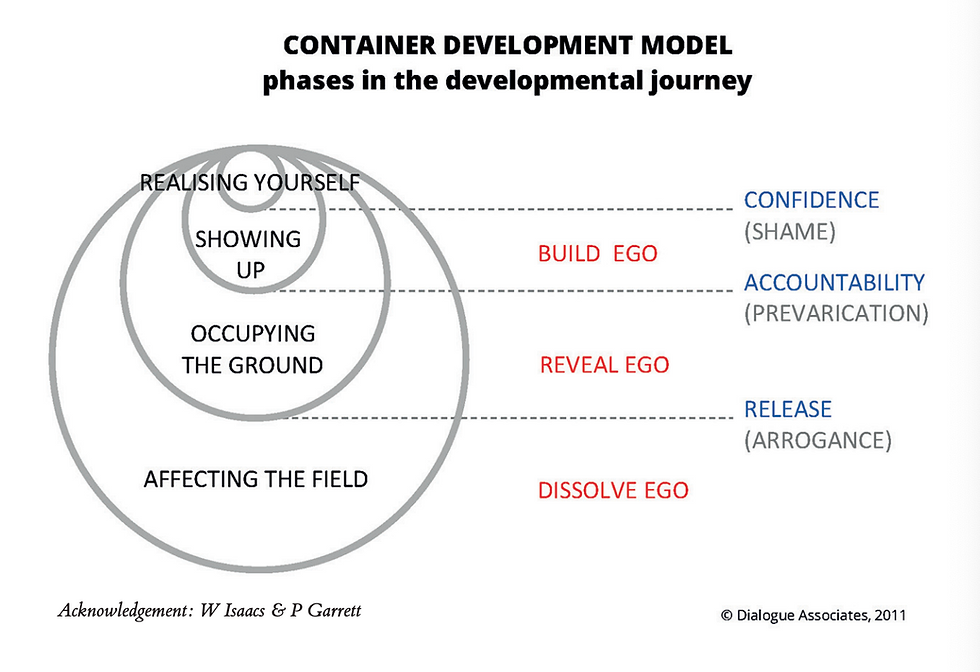
Stepping back, it is possible to see a growth within me alongside my outer career development during the three-year period I have just described. There is a sequence of phases. As I began I was naïve. I didn’t know what I didn’t know, and fortunately I was very receptive to learning. This is when I was realising myself. The name I use for this first phase has a deliberate double meaning – it was I who was realising how things fitted together, and I was starting to make my own potential contribution real. It involved talking with people, asking questions, reading files, speculating, theorising and knowing there was more to be seen and learnt. The second phase I now call showing up. I was progressing. At times I stepped into the spotlight as I led project management considerations, made new proposals in our partners meetings, recommended investments we might make and represented the company to others. When I got it right I was well acknowledged, and when I didn’t I tried to recognise how I could have done it differently (sometimes reluctantly), and endeavoured to learn from the feedback I received. I was lucky to have so many projects to activate and to learn from. I had to respond to circumstances, like moving gypsies off one site to regain possession.
Then I started to find my own direction and purpose. In a run-down part of London where we owned a couple of boarded-up derelict shops, I felt the area had lost its heart. It lacked pride. I imagined a covered street market alongside a shopping arcade that would give it a lively centre and attract people who wanted to be there. I began to acquire the additional neighbouring units, and options on others, to pull this off. This was the phase of occupying the ground. My inner confidence, purpose and commitment were now defining my own way of doing business, and I was good at it. In a further phase, people could see I knew what I was doing and started to come to me for ideas, advice and guidance. I had become influential within the company and beyond, and I helped to define the spirit, purpose and integrity with which we worked and were known to work. I was now affecting the field.
I have experienced and seen these four phases unfold naturally in this sequence many times: realising yourself, showing up, occupying the ground and affecting the field. In each new situation or initiative the phases are similar, even though there is a different content of learning – whether as a child learning to ride a bicycle, as a parent having a first child, as a university student landing a first job, as a warden taking charge of a prison for the first time, as a busy CEO taking over another organisation, as an employee stepping into retirement, or as a widow having just lost her husband.
In the Context of Dialogue
I have found my understanding of these phases particularly helpful in my Dialogue work. Generally the inner development leads the outer growth of effectiveness. For example, typically as individuals show up more opportunities come their way. My favourite role is coaching an executive and his or her team on how they work together and with others to deliver a result though the best use of open Dialogue. In these dynamic processes, change is under way everywhere: in each of the individuals in the Dialogues; in the relationships between them; in the dynamics of the whole group; in their relationships and responsibilities with others; and in the overall situation and circumstance. The four phases provide a framework for understanding this complexity in order to be helpful in any transition. An individual may be an old dog in their current role, but still realising themselves in digital skills, or they may be occupying the ground with their family and the arrival of children, but still showing up in their new leadership role. The team may be showing up, whilst their larger organisation may still be realising itself. To be effective in Dialogue one has to understand the relationship between what is happening internally and what is happening externally. That is the key to releasing the dynamic value of Dialogue.
Supporting the Development of Others
Let’s step forward ten years in my life. I am now working as an independent consultant to the European division of an international energy company. I have been successfully coaching Tim, the chief executive, and his leadership team, drawn from across southern Europe, including Turkey, Spain, Portugal, Greece and Italy. Their business meetings start late, with espresso and strong cigarettes. They are informal and conversational, effective, and finish late in good humour. Then the announcement is made that they are about to be absorbed into (actually taken over by) a larger business unit to the north, including the sterner and more disciplined northern European powerhouses of Germany, Austria, Poland, France, UK and the Netherlands. A new cycle had begun.
I met the new incoming chief executive who would be replacing Tim to lead the enlarged business. I agreed to support him in this new role. Ewan is a pleasant man, a Scott with a broad accent, and a qualified accountant. I noted that he is honest, enthusiastic and astute, and that he is entering unknown territory in his job. This is larger, more complex and more socially demanding that anything he has done before. With this new initiative he was clearly in the phase of realising himself. I had a good idea what he would be going through during the coming year or two and how to help him.
The leadership handover was beautifully orchestrated. Normally decision-making stops when news breaks of a change of leadership, as those who will report to the new leaders wait to see what changes he or she wants to introduce, and how to position themselves to be seen to be of value. I had seen gaps of three or four months where all major decisions were on pause. So I counselled the two of them to minimise the handover period. We called a twoday meeting of the enlarged Executive Leadership Team meeting two weeks later in Istanbul.
Tim, the outgoing leader, led the first day. He reviewed the state of the business with everyone. Ewan was seated quietly in the background listening carefully and starting to realise the situation. In the evening we took a boat down the Bosphorus. It was a balmy summer evening as we sat on the large open deck watching the Istanbul suburbs drift past on our outward journey. We ate and drank, then dropped anchor to celebrate and acknowledge the role Tim had played. He was popular, good at his job and sometimes absent-minded, which all added to the good humour of the occasion. He appreciated the gifts he was given. Then we raised anchor for the return leg, and as we did so Tim symbolically handed over the leadership to Ewan with a firm shake of hands. We sailed back, and before breakfast Tim had departed.
Ewan led the second day of the meeting. We had talked about how he would show up in that meeting whilst he was still realising himself, and designed a good way to manage the situation. He began by saying that he was not Tim, and clearly he would do some things in a different way, because he was a different person with a different history and a different set of skills, but first he needed to understand their thinking about the business. We had two rounds where everyone spoke in turn. In the first they introduced themselves and said how they would like to see their part of the business develop over the next year. In the second round they were asked what, if anything, they would like to change during the next month. It was a clever way to start. He had put the initiative in their hands, which was sensible since they knew more than him, and sustained the momentum by asking to hear about immediate decisions to be made by them. He had managed his own naïve phase of realising himself without giving away his authority.
As things worked out, the business flourished. It had the advantage of a full European trading presence and rationalised its investments in a different way in consequence. Then the larger multinational organisation made the strategic purchases of two strongly branded competitors in Germany, thereby adding these businesses into Ewan’s remit and significantly expanding his turnover. He was now showing up as confident to lead the integration of the new German businesses into his existing portfolio. There were cultural issues to face, however, before he could do so and fully occupy the ground. I called on a German colleague to co-facilitate some of the sessions as we resolved this.
The challenge was that Ewan valued thinking openly with everyone before making a decision. The new German executives, on the other hand, had just suffered a takeover by Ewan’s parent firm and presumed they should agree to whatever he wanted. So he was encouraging open thinking and they were careful to agree with everything he said or might mean. It was politely frustrating for everyone. Once they realised what he was actually calling for, they acted quite differently, often disagreeing and opposing him in strong and blunt terms. At some point Ewan would make his decision and want to move to action, whilst his German colleagues were still making alternative proposals. It became like a three-legged race again, and everyone became quite frustrated with the lack of flow and progress. I had to intervene and make clear distinctions between each part of the meeting. So in the first part they agreed the issues for consideration, in the second part it was open thinking with no decisions made, and in the third part Ewan defined the decision and they explored the implementation of it. Everyone had to play a somewhat different role for this to work. On Ewan’s part he had to be clear when he was ready to call a decision, explain his logic and be explicit that no further alternative proposals were welcome after that point. Gradually people understood this process and enjoyed the easy progress they made in consequence. Ewan had begun to occupy the ground in his own unique and effective way. I stayed with Ewan through perhaps half a dozen further business roles and he became an influential leader in his larger organisation.
Transitioning to the Next Phase
I had a good feel of how to be helpful in my executive coaching because of this simple sequence of realising yourself, showing up, occupying the ground and affecting the field. It revealed the developmental needs of the individual in a particular initiative. I have coached many different individuals, and on entering each new situation they ran through a similar sequence. I could see it in others, and I experienced it repeatedly in myself. There was the time when I took up skiing, for instance. Between the idea of skiing and first getting onto the piste, or ski run, there was a significant phase of realising myself. It is a period of private enquiry. Am I fit enough to do this, or is there some set of exercises I should find at the gym? What do I wear? Is my walking anorak OK or do I have to invest in an alpine outfit in flashy colours? I didn’t know what ‘normal’ looked like. I asked people if they were skiers and found people who knew a bit about it. Younger people used snow boards and older people skis. My age placed me firmly in the skiing group. I discovered some resorts are better for learners than others, and the prices vary, but it is not inexpensive.
Eventually the day arrived when I was dressed in my full new dazzling yellow and black kit (covering new ‘wicking’ underwear and thermal vest), helmet and reflective goggles. Of course I had tried it all on at home in my bedroom to reassure myself, and I was satisfied I looked good. But now I was at the ski resort in full view of everyone and I felt highly visible! What I had not taken into account was the boots that lock into the skis. They are designed for the skier to be leaning forward at an angle, and as a result it is very difficult to walk wearing them whilst carrying the skis. So I hobbled from the ski hire shop to the snow, with the skis and poles slung awkwardly over my shoulder. I locked the boots into the skis, and there I was, ready to go. What happened next? Well like any typical beginner, I slid a few yards and fell over. So this is learning through mistakes! Pleased I also booked some lessons . . .
Getting from showing up to occupying the ground in skiing is more difficult than I had imagined. This is because you have to learn to move your body in a way that initially is counter-intuitive. If you try to remember which way to move, by the time you tell your body it is too late and you have fallen over. You have to feel the motion in your body. Let me explain the problem. When I learnt to ride a bicycle as a youngster, I leaned to the left if I wanted to turn left, and I leaned to the right if I wanted to turn right. That is the way to maintain balance. I later did the same on a motorcycle at much faster speeds. On skis it is the other way around. If you intend to turn to the left, you lean to the right! The outer right edge cuts into the snow increasing the friction, and that turns you to the left. If you lean the other way you have no cutting edge, slide wildly and fall. Understanding this is only a small part of doing it. But there is more. If you are about to drop down a steep slope, intuitively you lean back, as you do going down an incline in your hiking boots. But on skis you will fall if you do that. Instead you have to lean forwards, propelling you even faster down the slope – and the steeper the incline the further forward you have to lean to keep your balance. This is scary stuff! But without mastering these two rather elementary requirements you cannot occupy the ground, because you find yourself instead lying on it. It takes more than skill; it takes an adventurous courage to be any good, and there are more than a few would-be skiers who lose their nerve. I found that the way to get there is to stop thinking and instead to feel what is needed. And it really helps to watch those who know what they are doing. They can help you to sense the way to ski better. In that way they are affecting the field, and being in that field you can really benefit from watching them at a distance.
The Work To Be Done
It is probably becoming apparent that one does not simply drift from one phase into the next. There is a definite barrier to break and an internal shift to occur as you move into the next phase. Realising yourself is a private matter. Your enquiry proceeds at whatever pace you choose, or whatever time you have available to you, exploring whatever sources you can find. You can read, ask, experiment and speculate, without anyone else knowing what you are up to. When you show up, however, it is apparent to others. You are visibly taking a position and people may or may not like it, and they may or may not agree with you. If you have done your work realising yourself, you will have good reasons for doing what you do, and it will help you if you explain them to others. Essentially it has been a phase of building the ego.
So the challenge of showing up is one of confidence. It is about revealing the ego. If I have failed at something I wanted to do in the past, and in particular if I have been shamed or ridiculed by others, then showing up can feel like a dangerous step for me. It is worth considering this in an organisational context. I don’t know how many times I have seen a junior rise to the challenge of expressing their different view in an important meeting, only to be slammed by the most senior figure in the room. It results in feelings of humiliation in the meeting, tears in the washroom and the future withholding of relevant information because of the proven dangers of expressing one’s view. This is not at all uncommon. As a result, an essential organisational skill in leadership, facilitation and coaching is helping individuals successfully through the barrier of showing up. It is important that individuals gain the confidence to do so and, generally speaking, that ease is more important than whether the views they first express are ‘right’ or ‘wrong’. As they get confident showing up they will express their views more clearly, and the thinking behind the views will be more logical. Without hearing from the people affected, however, leaders and decision-makers will be largely flying blind.
Sometimes people are expected to show up before they have done the preparatory work in the previous phase. When this is the case they come over as hollow, because they know the words but not the meaning. They spend hours rehearsing their lines, or use PowerPoint slides to remember what to say because there has been no corresponding inner developmental work. So we have the outline of a coaching model whereby we can recognise where an individual, team or organisation is in a particular initiative, and help them to fill out that phase and move into the next.
The shift from showing up into occupying the ground is a different challenge. As a manager or supervisor you will have noticed bright juniors who will soon be ready for promotion. They show up in meetings in a convincing way, and have initiative and self-confidence. Perhaps you recommend they apply for a promotion, but they may or may not do so. Showing up is something you do at the right occasion. You may even perform on the stage several times a week, but that is not all day every day. Everyday consistency requires real commitment. A girl might have a boyfriend for a summer, but having a child is for a lifetime. This is about sustaining the ego. A promotion may result in better pay and conditions, but it has responsibilities and accountabilities attached to it. The new role may put that individual in sole charge of some activity or part of the business, answering to more senior people, and that requires a different stance. In my 20s I worked temporarily as a barman in London, and loved it. Later, in my 30s, I held the liquor licence for the 20-bedroom hotel I was managing. They were similar but completely different roles. As the barman I locked up my bar at night and went home without a care. As the hotel manager I was paid more, but I was continuously accountable. I had calls in the middle of the night and had to get up and deal with them – the police advising a break-in, or a guest complaining that the bath water in their room was only lukewarm!
There can be a tendency to prevaricate and procrastinate. People avoid or put off stepping into the next phase of occupying the ground. The person involved may be quite capable of doing a more senior job, but they may not be ready internally to take on the responsibility. If they do eventually bite the bullet and occupy the ground, they do find that there are consequences. When you are the only one responsible, you have to find a way of managing things. There may not be anyone there to advise or guide you, but still you have to act. You start to gain some first-hand knowledge beyond simply doing what you are told or following the rules. Your way of doing things will be different from others because of your personality, experiences and cultural inheritance. Something else occurs, which is unexpected. When you occupy the ground some people come closer because they are attracted to your way of working and your commitment. They want to work with you. Others move further away from you. Your commitment is an inherent challenge to their prevarication and procrastination, and they are uncomfortable being too close to you. So occupying the ground develops a kind of intensity that attracts and repels. It is hard to predict who will come closer and who will move further away, but a sorting out definitely starts to occur.
An Expensive Lesson
Occupying the ground for an extended period builds a body of knowledge and experience about how to manage a particular activity successfully, and what not to do because it will be counterproductive. How do I know? Because I have done it! That is the typical stance of someone who has occupied the ground extensively. But there is a further phase – namely, affecting the field. Again there is a barrier and challenge in making this transition. It is necessary to release some aspects of your experiential knowledge whilst remaining fully committed to others. Let me give you an expensive example where this did not happen. I was invited to intervene in a joint venture pilot that was intended to result in a US $5bn manufacturing business. Two leading companies in the field, from Canada and South Africa, had joined forces to develop an innovative technology. Both had proven prior experience and knew that they knew how to do this work well. The problem was they had different methods and different organisational cultures. They were unable to listen to each other and to learn from each other because they already knew! It was not just a failure of communication – it was a failure in the developmental work needed within each organisation to move beyond their arrogance of having occupied the ground. They could have affected the field internationally with their innovation, but instead the joint initiative simply failed.
The fact that you and I really do know how to do something, and have proof that it works, does not mean that our way is the only way to do it. Finding God through Catholicism does not mean that others cannot find God as a Jew, Hindu or Zoroastrian. If my way definitively excludes other ways, then I cannot affect the field. Whilst remaining committed to the essence of the work, I have to release my ego – my attachment to my way being the way, if my influence is to be extended further into the field. Reputation is a powerful thing. There is not one way but a thousand ways. Each person and each situation is unique, and an intention to foster the unique work of others is what underwrites the ability to affect the field.
The Developmental Phases in Conscious Awareness
Let’s drop into a different endeavour. Back in 1984 I was working with David Bohm on understanding the workings of human consciousness. We believed there was a pervasive defect that took the form of fragmentation and it broke up the sense of common meaning between people. It was the root cause, in our view, of most of the problems facing society today. We used median-sized groupings of 20 to 40 people (that are too large for family dynamics and smaller than societal ones, as originally advocated by Patrick de Maré) to identify and talk about our own changing state of conscious awareness as it occurred. One thing we noted is the difference between thinking, which is new, and thoughts, which are replayed past-thinking. Thinking is slower, whilst thoughts can be prompted very quickly by association, provocation, threat or desire. Thinking is a higher level of living, subtle awareness, that can influence which thoughts to entertain and which thoughts to let be. Thoughts, on the other hand, are replayed from the past and cannot manage immediate thinking. Although both are needed, we found that thinking is quite rare. George Bernard Shaw once proposed that most people think only two or three times in a year, and that he had made an international reputation for himself by thinking once or twice a week! We found we were thinking much more often than that, because that is what we were intentionally setting out to do, but it was still quite rare for many participants to get beyond their memory.
I have not forgotten one delightful evening when a group of 25 of us were in Dialogue together in a friend’s apartment in Kensington, in London. A colleague, Mike, began to see what was happening for the first time, and he spoke about it in a delightful way. He said, “A thought coming towards you is very different from a thought moving away from you!” He explained what he meant as we all talked about it together. He had felt his initial impulse to think. It was the start of an energetic movement that as yet had no form. It was emergent and urgent, although it was unclear just what it was. Gradually it began to form itself into an idea with purpose, and to be meaningful to him and perhaps to what we being considered in the room. He found words appearing to clothe the idea in language, and as he listened he started to choose some sentences to place his idea into the Dialogue. I find it hard to think of a better name for this first phase than realising yourself. He had described what he called ‘a thought coming towards you’. It was actually a subtle thinking process that was emerging into articulation through words, which are thoughts.
Then he spoke a few sentences, adding his contribution to the ongoing conversation. From that point he was showing up. The private process that had been occurring within him had become a public one now occurring in everyone. It was entering the awareness and thinking of others in the room, and they did different things with it. Some liked his idea, some liked the intention but not the words, some thought what he had said was irrelevant to the main theme of the conversation, and so on. This is what he called ‘a thought going away from you’. It was now with other people. He could feel his own impulses to explain more, to defend his idea, to laugh and to be silent. He had the opportunity to continue to think, and to continue to describe the movements in his consciousness, including what occurs when someone else’s thought moves into him. By doing so it would lead to him into occupying the ground – in this case the ground of conscious awareness. That is exactly what many of us did, and thereby we affected the field in terms of the emergence of a new kind of Dialogue. What was very evident in that Dialogue meeting was that the live description of his thinking deepened the atmosphere in the room significantly and drew others into a more subtle sensitivity. Past thoughts were less inclined to flood in to fill the space, and instead people were listening to themselves and each other in a more receptive way.
Container Development
We later called this atmosphere the ‘container’. Why the container? Well, if you consider it carefully, consciousness is simply its content, including the unfolding and enfolding flow of that content. The container is the content and flow that is commonly held by those involved. This container can be expanded and deepened to enable a greater common content and a freer flow of understanding. What is not commonly held is fragmented, and held by some participants but not by others. So the four developmental phases I have been describing are a container development model. The starting point may be largely internal and unseen, like the seed in the soil. It is not apparent to others how things are unfolding and what is emerging until the shoots emerge and some form appears. Then it develops with fuller growth, deeper roots, flowers and eventually the fruit that yields the next seeds to affect the field.
I use this container development model widely in all my work. The container development phases are depicted in many of my models – they are the expanding grey developmental circles, for example, in this graphic of our Dialogue practices, which are at the core of my Dialogue work. They are a reminder that each of the practices develops through the four phases as you grow your own personal container and capability. The same is true of a team that learns to listen better as the container develops, for example – not only to what is said but to what is meant and to the process of thinking and feeling behind that. This is the way into a deeper Dialogue.
A Developmental Framework for Consulting
The framework informs my consulting intervention work too. Here I combine it with a number of other key models derived from my practice. On being invited into a new situation to help, I am very conscious that at the outset I am naïve. I don’t know what I don’t know, and I am carefully attentive to all the clues I can find as I start to realise myself in that context. I am willing to learn from anyone and everyone. I enjoy my naïvety because it is a time when I can ask about peculiar anomalies and contradictions without being either clever or stupid. It is a valuable time that only happens once in an intervention and is soon lost. This is a time of enquiry, not a time of advocacy. If I understand why things have unfolded the way they have, then I can intervene in a way that enables them to unfold more generatively in the future. Showing up in intervention work is necessary to gain the authority to learn with people in the organisation or community. We will all learn more if I show up in the right spirit. Occupying the ground allows me and others to attract a core grouping to do the work needed in terms of the support and challenge of the existing patterns of relationships and containers. It starts to be apparent why we have what we have, and how to intervene for it to change generatively. This needs authority and right use of the organisational power structures. Affecting the field goes broader and deeper.
And a Career
Perhaps a final example is how the sequence of phases helps me to reflect on my own Professional Dialogue career as a whole over 35 years. The realising myself phase was during the eight years I worked with David Bohm in private Dialogue Weekends. I started to show up in corrections with my Prison Dialogue work, starting with a nine-year stint working in an English prison (HMP Whitemoor), and in organisations starting with my work partnering with Bill Isaacs (the Leadership for Collective Intelligence programme). My 20 years of partnership with my friend and colleague Jane Ball has led to the substantial ground we have occupied in our joint consulting company, Dialogue Associates, and the design of the Integrated Dialogue Model. Then we and others deliberately started the Academy of Professional Dialogue in 2017 with the intention of affecting the field.
And that is what we are starting to do . . .
Conference Session Extracts
From a conversation with participants considering the paper with Peter Garrett
Peter: What does Realising Yourself mean in a few words? (Various responses: Finding a new need and putting yourself in a learning position; self-actualization; preparing yourself for your future endeavour; understanding; as you begin you are naïve – you don’t know, and know you don’t know.)
Speaker: When you think of someone who’s newly promoted into a leadership position, they are going to have to find themselves and work out how they fit into this new role moving forward.
Speaker: Maybe a supervisor who has been in that job for a considerable time, but they’ve lost their ability to show up. They may need to be reminded of the importance of being visible, showing up.
Speaker: In our small group I made the point there are a lot of really professional, well-educated women that take a lot longer to show up, perhaps, than their male counterparts.
Peter: Why do you think it is, in some organisations, that women have more difficulty showing up?
Speaker: I can only speak for myself. It took me a long time to learn to show up and then actually experience how beautiful it can be to occupy your ground and see what effect it can have on others. I don’t know. Maybe it’s how we’ve been educated, maybe family relations or whatever, an experience that nothing’s ever really good enough. Maybe it’s also cultural in Germany, but I notice it in a lot of women that I’ve come in contact with, where I see the brilliance and they sell themselves short.
Speaker: I’m working with a senior leader right now who’s had to step in to be the head of something, because one of the partners in the firm left. She knows how to do this, and she was really comfortable before, but there’s this question of confidence. So I think you’re right. It really is a point of sustaining the ego to occupy this new ground.
Speaker: I think that we in Finland have this cultural problem that you are expected to go from realising yourself directly to occupying the ground without the showing-up phase. And that’s a real problem. People are not allowed to test their skills and their ideas, because everybody’s expecting that if you are showing up, you should know your stuff, be really confident about it. I think that’s harmful for new entrepreneurs and emerging experts.
Speaker: Occupying the ground is really embodying your role confidently, effectively relying on your own impact. If you are going to occupy the ground, you have to take accountability. You have to say, okay, this is my job. I’ll get this to work.
Speaker: In occupying the ground. I think it’s a good opportunity to look at how you can improve something. You’re actually trying things out, seeing what worked well, what didn’t work well, making the adjustments. In the first stages you’re gaining the knowledge, then in occupying the ground you’re wising up. But you actually learned that by occupying the ground in my mind.
Speaker: I think sometimes you see that people have potential, but they don’t have the confidence to step out. So as leaders, it’s your responsibility and due diligence to align them with the opportunities to extract that potential. It is twofold – you’re helping them, but what they’re doing will, in turn, help the organisation. It also allows them to have buy-in to what you’re doing.
Speaker: Affecting the field effectively means we go back to a place of being humble, because it’s almost like where you were before realising yourself, but in a different way. You have humility, but you have the confidence at the same time – it’s a conscious humility of giving space to others.
Speaker: I give myself six months as a new Director to show up and to get to know the agency. After I have realised myself, I show up and then I am prepared to do what I was brought to do, which is to begin to occupy the ground. And part of that is building a team, shifting the culture and doing all those things necessary to get the outcome ultimately. In Virginia the data and research will show you how our culture shifted over the years. That’s an example of how you come in – you begin by realising yourself, then showing up and occupying the ground causes those things to happen on the back end. So that’s the way it plays out in my mind and what we have been doing.
Speaker: Peter, when I read your paper, I really thought about the idea of selflessness as you move into that area of affecting the field. It’s a choice you make to do that. And I think about it in terms of an organisation. You recognise the value and purpose of the organisation, the impact of the organisation is greater by bringing others in and sharing that information and knowledge with them. To a certain degree that can be at the expense of the individual potentially, but it makes the organisation better and it helps the organisation accomplish whatever its mission or purpose is.
Speaker: So the Virginia Department of Correctional Justice could be affecting the field of correctional justice in the entirety or in parts. How, how are you doing that?
Speaker: Yes, we are achieving that effect on the field in the US. Last year over a dozen corrections agencies from other states came to Virginia to take a look at what we’re doing. So we are leading the cutting edge. I am sought after to speak often at meetings of directors and so forth. Other members of our team and overstaff are being called upon to share what they’re doing and their expertise too. Four years ago, I went to the National Institute of Corrections and spoke at a class of people aspiring to be leaders of corrections. I spoke about dialogue and a lot of the things that we are doing to change the culture of the organisation. This past Friday, four years later, I received an email from a gentleman in Arizona who was a member of that class who is now preparing to be a CEO, and he wants me to spend time with him helping him to go over all those notes that he took from me in that class four years ago. He has been watching us from afar and sees things are working. He liked what I said then, and he wants to put some of those things into place in a different state.
Postscript
The author’s reflections, written some months after the conference
The four phases of the Container Development Model were generally well recognised by participants, and there was some interesting exploration about the challenges of showing up in an organisational context. Also culturally, it seems in Finland there is an expectation that when you have realised yourself in some field you now occupy the ground – but without the intermediate phase of showing up. I believe this is true in some other cultures too. It is not uncommon for people to claim or pretend to know more than they do to hide the fact they are actually still showing up. This is unfortunate because the successes and failures in showing up are an essential part of learning, without which one cannot occupy the ground. Pretending one already does so usually makes people particularly sensitive to any lack of acknowledgement.
It set me thinking about how one learns and develops during the ‘realising yourself ’ phase. The container is smaller and private. The discoveries may be largely vicarious or informed more by the experience of others rather than one’s own. This is particularly the case in traditional forms of education, where reading and being familiar with the existing literature is a requirement for graduation, and graduation seems to imply occupying the ground. Describing what others have done, however, is very different from being able to do it yourself.
This is about different qualities of knowledge that are available in each phase. In the realising yourself phase it is often third-hand and derived from people you have not met, describing things. This may be fine for technical matters, but not regarding personal development. Watching and hearing directly from someone else about their own experience provides access to second-hand knowledge. This is more helpful, because you can sense the context, weight and authenticity behind what you are hearing. Both forms provide guidance that can be adapted and incorporated, but neither are first-hand. That only comes from showing up and trying it ‘live’ for yourself. Your experience and reflections are then very different.
Showing up involves a much larger container that includes others, and they will respond and react to what you do. Therefore, you have much more to handle when you show up, along with a far greater learning opportunity. Acknowledgement seems such an important factor in this transition and I am left wondering: just why?
© Peter Garrett, 2021
The World Needs Dialogue!
Three: Shaping the Profession
ISBN: 978-191619127