
Dialogue Through the Offender Resettlement Journey - Jane Ball
Updated: Jul 21
What is the purpose of the criminal justice system? Is it punishment? Or retribution? Perhaps rehabilitation? Deterrence? Public safety? While there is undoubtedly a little of all of these in practice, rehabilitation is at the heart of modern penal policy in the UK and US systems where I have worked. In my experience the reality of the aspiration to provide rehabilitation (defined as ‘the reintegration of a convicted person into society’) is hampered by the fragmentation of the criminal justice system that leads different organisations, divisions and people to act in isolation rather than together. The Offender Resettlement Journey (ORJ), created by Peter Garrett and me, is a Dialogic response to integrate the activity of the whole system – including the offender – to achieve the common goal of successful resettlement. The theory and practice of the ORJ is based on knowledge generated over many years of Dialogue with offenders and people who work in the criminal justice system at all levels, alongside our experience of organisational consulting. In this paper I’d like to explore some of the key features of the ORJ, how they developed, and the relevance of the ORJ for effective Professional Dialogue within the Criminal Justice System.
© Jane Ball, 2018
The World Needs Dialogue!
One: Gathering the Field
ISBN: 978-1916191204

What is the purpose of the Criminal Justice System? Is it punishment? Or retribution? Perhaps rehabilitation? Deterrence? Public safety? While there is undoubtedly a little of all of these in practice, rehabilitation is at the heart of modern penal policy in the UK and US systems where I have worked.
In my experience the reality of the aspiration to provide rehabilitation (defined as ‘the reintegration of a convicted person into society’) is hampered by the fragmentation of the Criminal Justice System that leads different organisations, divisions and people to act in isolation rather than together.
The Offender Resettlement Journey (ORJ), created by Peter Garrett and me, is a Dialogic response to integrate the activity of the whole system – including the offender – to achieve the common goal of successful resettlement. The theory and practice of the ORJ is based on knowledge generated over many years of Dialogue with offenders and people who work in the Criminal Justice System at all levels, alongside our experience of organisational consulting. In this paper I’d like to explore some of the key features of the ORJ, how they developed, and the relevance of the ORJ for effective Professional Dialogue within the Criminal Justice.
My Journey with Dialogue in the Criminal Justice System
Over the last 19 years my work has been based entirely on Dialogue in many fields, both commercial and social, and continuously within the Criminal Justice System. Over this time I have worked in 15 different prisons in the UK, and in six different State and city corrections departments in the US, under the auspices of the charity Prison Dialogue and the consulting business Dialogue Associates. I am director and co-owner of Dialogue Associates with Peter Garrett, who has been my teacher, mentor and colleague continuously throughout this period. We have partnered on many initiatives, co-designed, facilitated and supported each other in the intervening years.
When I started the work was focused on improving the prison, without any additional resourcing or policy changes, through Dialogue and the way that people talked with each other. As we developed partnerships with prison Governors and senior managers, they asked us to use the Dialogues to address specific issues. For example, conflict between a healthcare provider and the prison operation and security staff; the transition from one prison Governor to another; an Equality and Diversity review across prison policy and practice; and union management strategy. Our thinking, practice, and vision also moved from unit-level Dialogues for staff and prisoners to whole-prison transformation, to groups of prisons working together with local communities, to state-wide systems. The core of the work has been bringing together people from the different, and relevant, subcultural groups to address individual and collective thinking within the Criminal Justice System. Things change as a result. The practice, theory and skills have developed through repeated application and practice here, as well as drawing on work in the commercial sector.
Most of the work has involved the engagement of offenders. Time after time, I have seen individuals flourish through the experience, and start to take hold of their own lives, and I’ve witnessed the awakening of an intelligence in the system that is not often included in decision-making. Why wouldn’t the whole Criminal Justice System provide the conditions for this change to be nurtured in everyone? Why wouldn’t it provide a place for a generative, rather than destructive, relationship between the offender and the system? We have developed the Offender Resettlement Journey through practice over many years, driven by the desire to create such a system – or to provide the conditions for its creation. It is a now a fundamental framework for our Professional Dialogue work in the Criminal Justice System.
The Offender Resettlement Journey in Theory and Practice
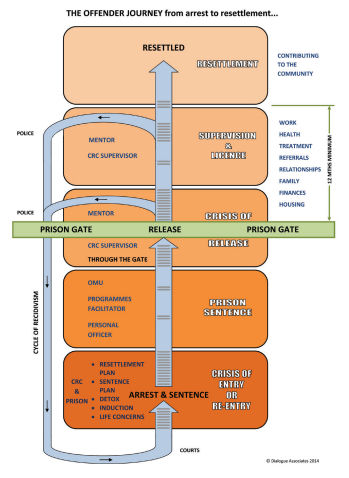
The Offender Resettlement Journey tracks the ‘archetypal’ path of an offender. It is the journey an offender takes from committing an offence and arrest, through sentencing, incarceration (although not in all cases), supervision by probation agencies in the community, release (from prison or probation commitments) and re-entry into the community, then resettlement - to be independent and law-abiding, and ultimately to make a positive contribution to their community. I have heard many, many stories from offenders over the years, and of course everyone has a unique experience. Despite the variations, we have found core features of the ORJ: common routes, transitions and crises, things that help people to succeed and others that trip them up. Understanding this helps to make those journeys a success in life; and informs the design and facilitation of ORJ Dialogue interventions. Here are some of the characteristics we have found.
The offender journey is material. That is, the physical experience progresses from court to a prison cell, to a probation hostel, a bedsit, and possibly to home with your family. Your clothing, accommodation, meals . . . everything changes. It is relational. As you are incarcerated you say goodbye to your family and friends, and in prison you share a cell with someone you have never met. You live closely with a large group of strangers and have a range of personal and professional relationships. When you return home upon discharge, you try to sever ties with offending ‘associates’. The offender journey is emotional. It consists of anger, sadness and loss, despair, desperation, hope and expectation. It is mental, in that your thinking changes as you learn to navigate a new environment with different rules, norms, processes and ways of working and living. The journey travels from dependence – be it on drugs or alcohol, someone to unlock doors, social security or health benefits – to independence and, with it, increasing choice about where you live and work and spend your time.
Finally, at its core, this is a journey of identity: from offender and prisoner to worker, student, entrepreneur, father, mother, neighbour. (This is why the naming of those who have offended society and its laws is so significant. Are you a con, inmate, offender, prisoner, man or woman?) The journey may be a one-time passage from arrest to resettlement, or it may repeat and repeat, each time activating the whole cycle, with identity at its centre.
There are some key points in the journey when circumstances change, and care and attention is required to navigate these successfully. As on a road trip, things are different when you depart – you realise the petrol gauge is low, you forgot your bag, can’t remember if you locked the back door! – to when you are cruising down the motorway and the only choice is whether to turn the radio on or what speed to drive. They are different again as you arrive – traffic builds up as you reach a major city – and then you are suddenly at a stand-still and you don’t know why.
As an offender enters the Criminal Justice System they may be waiting for the police to pick them up, preparing to go to court or be incarcerated, saying goodbye to family, drinking their last can of strong lager, or trying to get hold of drugs that they might try to take in with them. They may know it is coming, or the police break through their front door in the middle of the night. Whatever the specifics, something strong and particular happens at this point. We have called it the Crisis of Entry. As the offender’s release from prison approaches another crisis arises: the Crisis of Release. A new range of questions await: Where will they go? Will old associates be waiting for them? Will they be able to stay clean? What they will do for money? All this, combined with the excitement and anticipation of freedom: choosing what to wear, eating good food, seeing their partner, being with their children . . .
Once across the threshold of the prison gate the reality of coping with those freedoms hits home: Why did the police just stop me? What do I do about the noisy neighbour? What do I tell that employer about where I have been? How do I get to see my probation officer at noon and my drug agency at one in a different town? These are all real challenges that I have heard offenders talk about during Dialogue work, reflecting on what went wrong and sometimes looking ahead to how to manage. These transitions are intentionally named as crises because it is very easy for things to go wrong, and people feel – and are – vulnerable. During research work for the UK Ministry of Justice, offenders described a crisis at the end of their probation supervision in the community, when no one is watching what they are doing any more, there are no routine visits, and no advice or interest. We found that each crisis could be managed best with a ‘clear line of sight’, a view of the whole journey to resettlement. With a clear line of sight offenders can see the route ahead, anticipate problems, discover what is required and make better decisions as a result.
Fragmentation in the Criminal Justice System
In my experience most people who work in the Criminal Justice System are remarkable, dedicated and resourceful individuals. They work hard and achieve what is required of them in demanding conditions. According to where they work they have a different focus: it may be running an orderly regime (lock and unlock prisoners, serve meals, supervise movement around the prison); testing urine for drugs; checking where probationers are living and working; managing the budget; delivering a treatment programme according to set guidelines; tracking of the number of assessments completed within a set time-frame – any one of the hundreds of tasks required to run the system. Staff meet their targets, yet are not routinely expected to consider their impact on the offenders’ journey to resettlement, nor to take an interest in what other parts of the system are doing. The education department in one prison where I worked complained repeatedly that offenders couldn’t complete their classwork because they were always late for their sessions. This was because they were held up by residential prison staff who made sure that the prisoners had what they were entitled to (breakfast, medication, a chance to raise queries) before they left.
Beyond the prison, fragmentation in the Criminal Justice System is even more pronounced and difficult to address because it is part of an open system. In an open system, even though the offender may still be under the jurisdiction of the Criminal Justice System, there is no one person to whom everyone ultimately reports, as there is in even the largest multinational corporation, who can lay out the common purpose and expectations.
Dialogue can support a successful journey to resettlement and provide something of an antidote to fragmentation by providing the opportunity for offenders to talk and think about their situation with the right people who are part of that journey. For example, Dialogue between offenders, family members and probation staff will help people prepare for family life, with the demands that a probation licence dictates. However, the Criminal Justice System is complex – multiple agencies and many people affect the offender journey. The ORJ reveals the interconnectedness of the agencies, and the departments within agencies, through the perspective of the offender, and their common goal of creating successful journeys. Criminal justice staff start to think from an offender’s perspective about the current conditions, their role in creating them (whether they are a prison officer, drug counsellor or senior leader), and what they can do to improve those conditions. With that awareness and use of Dialogue skills to talk and think together, everyone can act more intelligently and make better decisions. The awakening in staff in Dialogue groups when they are given a chance to talk and think with offenders and colleagues is inspiring. Some staff respond in action, such as the semi-retired prison officer who galvanised local agencies to come into the prison to offer their services, rather than waiting until prisoners were released. Others notice the quality of the engagement, such as the police officer who told me he talked about things in the Dialogue that he had never spoken about with his wife.
ORJ Intervention Skills
The ORJ as an intervention requires vision to create an integrating image that reveals the interrelatedness of the system, convening skills to include the right people from the right parts of the system and Dialogue facilitation skills for working with offenders and different agency subcultural groupings. In the pages below I will describe four examples of ORJ work in the Criminal Justice System that demonstrate these skills and vision in action to begin to address the problem of fragmentation within the Criminal Justice System. Along with other interventions and experiences not included here, they have been foundational in building the understanding that has underpinned the theory of the ORJ, and in developing the skills and experience required for a Resettlement Journey intervention. Each one is a also valuable Dialogue intervention that could be replicated, with the right support.
Facilitation Skills to Change the Discourse
Staff–Prisoner Dialogue At HMP Blakenhurst
Context
This was one of my first experiences of Dialogue work in a prison. In 1998 Prison Dialogue had been awarded the contract to run monthly two-day Dialogue groups at HMP Blakenhurst, a private prison in the Midlands region of England. I joined in 1999 and facilitated Dialogues between prisoners, staff and managers there for up to four days a month until 2003. Though the Governor in charge of the prison at the time was interested in the potential of Dialogue to improve the prison environment, it was only the requirement for the prison to run non-accredited programmes that enabled us to be there.
The Work
The aim of the work was to improve relationships between the sub-groups of prisoners, staff and managers, and hence their experience living and working in the prison. Therefore, the Dialogue groups were roughly structured to represent a microcosm of the prison. Up to 20 prisoners from each of the four housing units, two uniformed staff and one prison senior manager (different each time) participated. It was socio-therapeutic in that people could work out issues in the social dynamic of the group. At times they gave and received direct feedback from other people, and they learnt about themselves by listening to others. As one prisoner noted after the sessions, “Hearing ourselves speak has helped us understand ourselves and others”.
We met for two full days each time and talked together without a set agenda, allowing the theme to emerge from the group. The first challenge was that some people – offenders, staff and managers alike – didn’t want to be there at all. A check-in, in which each person was invited to speak in turn, got everyone engaged immediately, listening, talking, thinking about what they would say, interested in other people, and usually having some fun. A check-out at the end of each day allowed the content of the Dialogue to settle and prepared participants to transition to relationships back out on the prison landings.
Once engaged and with the permission of an open agenda, the sessions typically began with prisoners complaining about prison conditions, poor food, lack of rehabilitation, behaviour of some staf, etc., and petitioning staff and managers for improvements. At times facilitation needed to be strong, enabling people both to vociferously put forward their point of view and stop to listen and understand the perspective of others. As all sides offered this to each other they learnt more about why things were the way they were, how things might be improved and (probably less often) what was good about this prison.
We began to deliberately introduce the Dialogic Practices in sessions: Voice, Listening, Respect, Suspension. We explained that Voice meant to be genuine, not saying one thing in the room and something different outside of the room. Listening was to give your attention and try to understand what others were saying and meant. Respect was to take the stance that other people thought and did what they did for a reason that made sense to them; even if it was not what you would do there was a reason for them doing it. Suspension was to hold your views openly, and consider why you thought what you did, like a chandelier suspended from the ceiling so that you could see it all of the way round. I learnt about the Practices from Peter. His input to the development of these Practices was based on his experiences in high-security prisons HMP Whitemoor and HMP Long Lartin, so they were powerful in this context. They made perfect sense to the prisoners and staff, and they easily picked up the practice and the language.
The Outcomes and Limitations
Month after month we created a good rapport between staff and prisoners in the Dialogues, even when unpopular staff attended, or housing units sent along their ‘baddest’ prisoners. Staff and prisoners found they had common interests; that is, prisoners wanted safe prisons just as much as the head of security did, but they lacked the understanding of the others’ perspective without Dialogue. The more focussed use of the Practices deepened the quality of the container. (The container is the term Peter introduced to me at that time, that names the quality of atmosphere among people.) I found that the Practices created a strong container that was safe enough for people to be more open about themselves. There was energy of genuine engagement and a quality of relationship that was unusual, and a feeling that change was possible. One prison officer named the changing dynamic: “At first I thought it was about inmate-to-officer but was pleased that we were able to speak as person-to-person.”
In this container we saw individual offenders transform as they realised themselves in the Dialogue group. Take ‘Eddie’ – in the first two or three sessions he attended he sat in the corner, arms folded, head down, refusing the opportunity to speak. I was surprised that he came back. By perhaps his second or third session when he was asked a question he responded with explosive street talk that was hard to even understand. Gradually his words became sentences, and he began to engage more critically in complaints about the prison. Then one day he started to tell his story and described in detail his offence, robbing people at a cashpoint (ATM). He described clearly his sense of hopelessness and inability to see any other way to make a success of himself, and the pleasure of being able to buy the designer clothes he wanted. In time he was able to talk more thoughtfully with others about his upbringing and community, and then to wrestle with questions about his future. There were other individuals like Eddie who came month after month to explore their life, their storyline, in depth. It is surprising how clearly I can recall those people, even after all these years. Eddie and others contributed to the container, and as a result other people could engage with the same questions about themselves, in depth, even if they were only there once. The focus of the Dialogue changed from ‘what others should do to make things better for me’ to ‘what I need to address to improve things for myself ’.
As a group I found prisoners more interested in thinking about their journey and resettlement as they found themselves in the safety of the container. As one prisoner put it to his group, “What is more important, that you can’t buy tuna on the canteen (prison shop) or that you need to deal with your drug problem so that you don’t end up back here again? What would your family want you to be talking about?” Officers who came to the Dialogues saw how they could have an impact on offenders’ lives. One officer, after attending a series of Dialogues, chose a new role managing the work groups who tended the grounds of the prison. As he told me, “We have Dialogue every day, and I can see what a difference it makes to [the prisoners], and I love my job again.”
The development of individuals and relationships between staff and prisoners was encouraging, but still there was no structure to take what was being learnt in the Dialogue into the wider prison or Criminal Justice System in a sustainable way. I remember thinking as Eddie was released that he needed to continue this quality of Dialogue in the community, but there was no way for him to so.
Learnings for the ORJ
Through repeated practice I learnt the critical facilitation skills required for this work, the foundation for any ORJ intervention. Most important is the use of – and encouragement for others to use – the Dialogic Practices, creating a container that enables a rich authentic enquiry with an offender about their life and circumstances. It leads even the most cynical staff to listen and understand the offenders’ experiences, and others to think about how they are leading their own lives. It is an engagement between people, not an interview or assessment, and that requires the facilitator to be equally authentic and willing to talk about their own experiences, thoughts and feelings, appropriately and professionally. “They left their key in the car and went into the shop, that was why I stole it”, said a prisoner innocently on one occasion, as if it was the most obvious thing in the world! I expressed my disbelief in no uncertain terms, and my straightforward, authentic response deepened the quality of Dialogue. The Dialogue facilitation skills also enable an effective conversation between subcultures. Over time, this moves beyond an us-and-them debate to a common enquiry. This is a necessary skill to integrate a fragmented system. A typical example of such a debate occurred between the prisoners and the Head of Security about security measures in the prison, particularly how family members were searched when they arrived for a visit. Facilitation encouraged them to listen to each other, enquire about each other’s views, explain their own and why they held them. As a result, they discovered their common interest in keeping the prison safe and secure, and beyond that, something of their common humanity.
The developing enquiries in the Blakenhurst Dialogue groups revealed how much more opportunity there was in prison to enable offenders to change their story, and therefore be less likely to reoffend. Many of the offenders had been in prison many times before, and their stories of how they came to be back in prison. (“It is like snakes and ladders: it’s hard to climb up a ladder, but when you slide down like a snake it is fast”, said one prisoner.) These repeating, predictable patterns revealed where the system was and was not working.
Mind the Gap
Resettlement KPI Conference with HMP Blakenhurst, HMP Brockhill and HMP Hewell Grange
Context
While our Dialogue groups in HMP Blakenhurst focussed increasingly on the offenders’ story of resettlement, HMPS (‘Her Majesty’s Prison Service’ in England and Wales) announced the introduction of key performance indicators (KPIs) relating to resettlement. The measures were the first time in the UK that prisons would be monitored on what was provided to help offenders re-establish themselves in the community after they left the prison. I had worked in two prisons adjacent to HMP Blakenhurst: a women’s prison HMP Brockhill, and an open prison (the lowest security level in England and Wales) HMP Hewell Grange, so we took advantage of our relationships there to centre a conference on these three prisons. The aim was to learn more about how Criminal Justice System could better support the resettlement of offenders – what was working, what was not and how things could be improved.
The Work
For the first time we created a map of the system that highlighted the factors affecting whether an offender was reconvicted or resettled. We played on the iconic wording from the London Underground notice that says ‘Mind the Gap’ as you get on or of the train, but here The Gap referred to the gap between incarceration as an offender and independent life in the community as an ex-offender.

As we began our conference, we required every subgroup to be represented at the gathering. We invited people by name from each agency and, if they didn’t reply, we called them until they did. If they were not available we asked them to send an appropriate representative, and we persisted until we had a guarantee that the right person would be there. I still remember Peter calling the Home Office (in the US, something of a combination of the Justice Department and the Department of Homeland Security) to ask them who they would send – and they did send someone! There were 45 participants, including police officers, magistrates, victim representatives, drug treatment counsellors, prison officers, prison managers, voluntary sector support staff, employment service managers, public health and social policy advisors, an academic criminologist, family members, prisoners and ex-prisoners.
The conference was structured around four themed Dialogues: ‘Arrest and Conviction’, ‘Imprisonment’, ‘Release and Resettlement’, and a final reflection on the whole journey. Participants sat in two concentric circles. Participants with direct experience of the theme – the aspect of the journey under consideration – sat in the inner circle and spoke in an open Dialogue. Those in the outer circle listened and added awareness, which they shared in observations at the end. As such, the Imprisonment Dialogue included the prison staff, prisoners, family members, while the police, magistrates, victim support, and the employment service listened from the outer circle.
Outcomes and Limitations
The primary outcome of the conference was learning about the fragmentation and interconnectedness in the Criminal Justice System. Agencies had little awareness of the impact they had on the ability of others to do their work. Drug treatment counsellors described how they could not work effectively in prisons because of lack of cooperation from prison staff who saw them as a burden rather than an asset to the prison, and policy advisors were disconnected from the experience on the ground, and were making uninformed policy decisions. Security staff could undermine prison visits through their attitude to family members, yet resettlement staff were trying to encourage strong family ties in the knowledge they improved chances of successful resettlement. There was little to no understanding between different phases of the journey, apart from the knowledge held by the offenders and their families. The Magistrate, who sentenced people to custody, was not interested in what it was like in prison. Police were told that how they made an arrest (always based on a professional risk assessment) affected how the offender thought about Criminal justice agencies, and therefore their attitude to prison staff once they were incarcerated.
As a one-of event, the session generated a high level of awareness and new understanding about the inter-relatedness of the criminal justice agencies, the offender and their family. Previously I had not thought of a Dialogue needing to lead to a plan of action, rather that each participant would make their own decisions about what they would do as a result of what they had heard and learnt. However, the Criminal Justice System is large and complex and the individual motivation at the end of the session was unlikely to lead to the policy or practice changes I could see were needed.
Learnings for the ORJ
The map, graphic and naming (The Gap) provided a strong and clear external display of the system that everyone could see and refer to. We could show Offender–Ex-offender at the heart of the image and depict the relative positioning of the agencies. The concentric circle design of the session reinforced the image. The offenders and ex-offenders were the only people seated in the centre circle for each Dialogue, and it was obvious that they were the only group to have continuous first-hand experience of every phase of the journey.
Participation by all relevant stakeholders is essential. With each perspective brought out by people talking openly about their first-hand experience, the inter-relatedness of the system and its impact is clear. As the Criminal Justice System is an open system – meaning that there is no one person with authority over everyone – it requires skilful convening to achieve this. This includes understanding and mapping the system to identify the relevant agencies or subgroups, sending invitations purposefully to the right people, taking care to explain why it is relevant for them to be there, and following up to secure their participation. In a closed system, with sponsorship at the right level, you can require people to attend. In an open system, where people do not have a common leader, you have to make the case for them to be there.
Threshold Dialogue
An Open System Working Together to Improve Resettlement
Context
From 2003 to 2006 Prison Dialogue worked consistently with the Governor (in charge of the prison overall), all of the senior managers and staff at HMP Dorchester in the south of England in support of a prison turnaround. Dialogue was at the heart of the transformation that took the prison from a ranking of 135th of 136 prisons in England and Wales in 2004, to 35th by 2006 – the highest ranking it could achieve for a prison of its type. It also ranked 1st or 2nd in the country across 12 different Measures of Quality of Prison Life (MQPL). The work at the prison was noticed by the Governor, who let us know that “The Director General called me to pass on his personal congratulations for what was seen as an extraordinary shift in the prisoners’ custodial experience”.
This was only the beginning. The vision went beyond the custodial experience to the creation of a whole-prison approach to resettlement. The Governor wanted the prison to be what was known as a “beacon establishment”, one that shone out among other prisons and had influence beyond the prison walls. Partnering with the prison Governor, we introduced our thinking about the offender journey and developed Threshold Dialogue to operationalise a wider partnership within the Criminal Justice System to reduce recidivism in the local community.
The Work
Bournemouth Threshold Dialogue was launched in January 2006 and for the next five years I worked to develop a structured Dialogue intervention, designed to address fragmentation in the multiple ways it occurred in this system: between different phases of the journey, particularly prison and the community; between different agencies and between offenders and the agencies; also between line staff (practice), senior managers (procedure) and chief officers (policy). In reality this meant that we created a network of interrelated Dialogue groups at three prisons and three community sites that tracked the offenders’ journey in and out of prison. We did not set it up as a grand design. The network was built over a period of time as we engaged regularly with groups of offenders and discovered what they needed. We knew that offenders experienced a crisis of release that builds up towards the end of their sentence and hits them as they step through the prison gate. The experience of freedom can be unsettling, and there is a lot of pressure to secure accommodation, income and medication, re-engage with family, and avoid past associates. We began in HMP Dorchester with Dialogues focussed on preparing for release, and then in the large seaside town of Bournemouth, where many of the offenders lived. The sessions were run on the same day every week within prison and the community – one week a young man would attend a Dialogue in the prison, and on the same day the following week he would be in a Dialogue in the community. This was particularly helpful for the significant group of offenders whose journey took them in and out of prison repeatedly, with sentences too short to receive any interventions in prison. They could continue to engage in the socio-therapeutic intervention of Dialogue regardless.
This was another open-system intervention; therefore, we understood that we would have to establish how Threshold Dialogue met the organisational interests of each and every one of the agencies to secure their participation. It needed to help them be successful in their day job. Every agency accepted that they needed to engage with offenders, but it was difficult to achieve. Few recently released offenders want to be seen talking to the police. It can take hours for a housing worker to see one offender on a prison visit. Threshold Dialogue provided engagement in quantity and quality. In a session with 15 offenders for 90 minutes they achieved 22.5 hours of engagement with offenders from their local community. The impact was significant. For example, police usually got to know offenders when they were arresting them, a time when there was little opportunity to build a relationship. They rearrested people time and time again, and as a result frequently held negative assumptions about offenders. In Threshold Dialogue they could support the offender’s thinking about their journey and build mutual understanding and rapport. I knew of a previously violent offender who willingly went to the police station with one of the police officers he had met in the Dialogue when he breached his probation licence. In the past that would have required force, a team of officers and probably some injury. Housing workers who got to know offenders in depth while they were in prison were more able to support them once they were released and dealing with the challenges of communal living.
Prisons, police, local government, housing providers, employment service, and a drug treatment service became primary long-term partners in this intervention. Their staff participated regularly in Dialogues at a number of sites, and some of them trained as facilitators so that the process could be self-sustaining. Facilitators worked in pairs and we created a reporting mechanism to support the development of their facilitation skills. This required them to listen and become more aware of what was happening. After his first session, one officer learnt that if he tried to remember good quotes he wasn’t listening, and he couldn’t remember what people said. If he just listened, he could recall significant comments easily. In time there were Threshold Dialogues tracking the offender journey – a local prison which incarcerated offenders serving short sentences, a medium security prison for those with longer sentences (many of whom started out at the local prison), and a young offenders institution, a night shelter and day centre for those whose lives were more chaotic, a supported housing unit for ex-offenders who were recently released, and at a community hall for people who were living more independently.
We developed the concept of the Line of Sight for the view that offenders have of their resettlement journey. We found that many offenders do not have a clear Line of Sight. They cannot see what they must do, either fully or in good enough time to succeed; or they get stuck no view of where they are trying to get to, or what they have to do to get there. Threshold Dialogue helped to create a clear Line of Sight for prisoners over their entire journey, with a destination worth aiming and for and manageable steps for each major transition. The participation of agency staff was critical – for example, staf from community agencies came into the prison for a Dialogue about preparing to be in the community.
The Threshold Dialogue system was supported by an Operations group of senior managers and a Governance Board of chief officers from every agency involved. This structure took learning from Threshold Dialogues into management and resourcing of operational services and the development of policy and strategy. After five years we held a Line of Sight event sponsored by the Local Criminal Justice Board to mark our withdrawal and hand over to local ownership. This included use of graphic maps and a spatialised offender walk (described in the following example) to display the system to itself.
Outcomes and Limitations
I witnessed and tracked changes in many individual offenders, including prolific offenders who were stuck in the revolving door of short-term sentences and short-term release who did not re-offend for the duration of our connection with them. Relationships between offenders and staf from every agency developed constructively. Interagency cooperation was more effective, leading to tangible service changes. As a direct result of Threshold Dialogue, a project was set up to provide a package of social security benefit, rent assistance, private sector accommodation and employment advice for offenders on release. One of the participants, the Manager of Bournemouth Safer and Stronger Communities Team, emphasised the value of Dialogue against this backdrop: “We talk about partnership working a lot, but I think actually what dialogue does is really strengthens some of those partnerships at various different levels – right from the people who are working on the ground, maybe managing offenders or ex-offenders on a day-to-day basis, in hostels, Police Community Support Officers and community workers, but also at a more strategic level: prison governors; superintendents from the police and community safety managers; probation managers; actually working together and understanding what the system looks like in their local area.”
The limitation was the lack of sustainability. Despite the achievements of Threshold Dialogue, including the creation of the local Governance structure and facilitation team, it folded once we withdrew. It was disappointing but not surprising. Local leaders (primarily in prisons and police) who had partnered with us to set up the programme had moved on, without establishing the commitment from those who replaced them. Without leadership, participation fell away. HMP Dorchester closed in 2013.
Learning for the ORJ
Through Threshold Dialogue we learnt about the larger offender journey, between prisons and into the community, and the experience and impact of repeated cycles of re-offending. This included the development of our understanding of and language for the Crisis of Release, Crisis of Entry and Re-entry, and the Line of Sight.
I believe that Threshold Dialogue helps offenders prepare for and successfully make their journey to resettlement and develops the skills of staff to support that journey more effectively. It requires widespread participation from criminal justice agencies – and we found participation can be achieved in an open system where agencies find the value to their individual organisational interests or targets. Even so, you need senior partnership and sponsorship. In an open system you need it across key agencies, from key influencers, and you must work hard to secure the commitment of new leaders.
ORJ for Organisational Development
A State-Wide System
Context
The ORJ can be used at scale for organisational development, as we have shown in a state-wide system in the US. This was the first time we named the intervention the Offender Resettlement Journey, and it was a consistent image as Peter and I partnered with the Director and his team to cascade Dialogue skills and practice throughout the agency. The foundation was completely different to anywhere else and, as a result, the potential was more significant. Working steadily with the agency over six years, all of their 12,000 or so employees were introduced to Dialogue skills for engagement and communication, every supervisor exposed to the use of Dialogue skills for management and coaching, and every leader to the use of a Working Dialogue pattern as a business practice for participatory change. The introduction to these skills included an organisational infrastructure to embed the training and practice of Dialogue in a practical way. This whole-system skill-building was cascaded from the Director and Deputies to the Executive team, every Unit Head, every Deputy unit head, on down through the ranks.
Intervention Design
The ORJ was introduced at stages alongside the other skills. At the first ORJ we included an ORJ ‘Walk’ event, held over an afternoon, within a Dialogue Skills Training session with executives and unit heads. In those early days the focus of the cultural change was the communication between ranks, up and down the chain of command in this hierarchical system. The aim of the ORJ was to introduce the idea that you could also think from the point of view of the offender, to understand the system and inform decisions. This was a challenging proposition for some people. It was a ‘walk’ because we physically walked an offender up and down the room to show their journey through the system from the point they were sentenced, to the current time – I’ll outline more about the spatialisation and facilitation below. It was an event because there was no structured follow-up. People were definitely moved and affected. The memories were at times very emotional and, for many of the leadership, a great reminder of the human impact of their work, in that they spent more time with emails and in meetings as a result of the walk. I remember one of the older warden’s touching reaction to being thanked by an ex-offender for the words of advice he gave him as his counsellor, perhaps 30 years before. The ORJ ‘walk’ had a personal impact on people, but there was no designed change as a result.
Later, as the Dialogue skills were in broad use across the agency and accepted because of their value, we ran three large-scale, in-depth ORJs to show the potential for organisational development. These ORJs focussed on a maximum-security prison, a medium security prison and a low-security prison in partnership with nearby Community Corrections districts. We worked closely with a steering group for each site so that locally they owned the process (from the research to identify the ORJ through their unit, to giving practical support to the design to the convening and logistics), the organisational learning and the resulting change proposals and implementation.
There were three phases. In the first phase we talked regularly with the local team to understand the flow of offenders into and out of their care and draw the graphic image of the journey centred on their prison. This required data to identify the common journeys and significant points of transition. The enquiry revealed five different archetypal journeys which we named on the graphics and provided useful language to refer five quite distinct experiences.
Local data informed the choice of which journeys it would be helpful to understand, and therefore which offenders, other prisons, probation units or other criminal justice agencies should be invited to the session. Where there were significant drug problems they selected and invited male and female offenders who had been incarcerated for drug-related offences and had been in treatment. Where prisoners we re-released on parole after decades of incarceration, they selected a man who had served nearly 40 years, and where they wanted to learn about the most challenging offenders they selected a man who had been in the highest security conditions and was working his way down the system. Other invitations were also made to specific individuals – not just any probation officer or Sheriff was invited, but rather a probation officer from the office who received most offenders on release from that prison, and the Sheriff who ran the jail that sent more offenders to that prison than any other jail.

Spatialised Facilitation
The second phase was a facilitated event, bringing the system together in one room. These days began with a process of engagement to build the container: first a check-in, then exercises and small-group skilful conversations to introduce and activate the Dialogic Practices. One check-in led people to think about their own journey through corrections (when they joined the agency, their first job, next job, when they expect to retire). Questions were posed to give permission to think about how the agency could be improved from a financial, operational and community perspective. The final question was a moral one – if your son, daughter, or some other relative was incarcerated here, would you be happy with the treatment they received?
Next we spatialised where participants were seated in the room. At one end were those who worked in the community, at the other end those who worked in maximum-security prisons. In between were staff from prisons at reducing levels of security until you reached the prison gate – represented by thick silver tape across the floor, or tables or chairs – something that marks a significant change between prison and community. Stepping across that threshold is a distinct and significant change for anyone, and the spatialisation has to represent that. Everyone was seated in a relevant place where there were no observers. Family members sat centrally in the community so they had clear sight of their partner or child as they walked through the system. Then Peter and I took turns facilitating a process for the ex-offender or offender to tell their story from the moment when they were sentenced, beginning with how long they were sentenced for, to set the length of the story. Sometimes they went back before then, and though we assured them they didn’t need to name their crime, many of them did. We spoke with them some days beforehand to help them to feel confident in us and comfortable about what would happen, but not to hear any details of their story. As we walk and talk we want to achieve genuine, spontaneous human engagement, not hear their rehearsed speeches nor our prepared questions. We included other participants as we went, turning to family members, a Sheriff, prison or probation officer or others, to ask what their experience was of the same journey. For example, turning to a mother to ask what they were thinking as their daughter was incarcerated for the first time, to a ‘zero-tolerance’ judge why he sent someone back to prison, or to prison staff who received the offender as they arrived in a maximum-security prison.
These offender walks were followed by a whole-group Dialogue to digest together what people noticed or learnt about the system by considering it from the point of view of the offender. Next, we facilitated a process of support and challenge to identify and name specific needs and opportunities that could be addressed to improve outcomes, stimulated by the earlier experience. This required focus and persistence, given the emotional as well as intellectual response to what people had seen and heard.
The final phase took each need or opportunity into a proposal and action, using a participative change methodology including engagement of offenders and other stakeholders. The proposals were integrated into the organisations’ reporting systems as business improvement projects.
Outcomes and Limitations
The ORJ led to greater awareness and understanding of interdependencies across the system and the benefits of thinking from the offenders’ perspective to see how the system works. As a result the agency is looking to embed the ORJ as a regular organisational development process, led by their own staff. On the whole, the proposals that came out of the ORJs were seriously considered and implemented, or rejected with clear feedback. Some simple, practical solutions were introduced (e.g., transferring money to offenders as they arrive in prison, or use of prisoner mentors in prison reception), and others addressed bigger cultural issues that were more difficult to shift, but at least they were being talked about (for example, the practice of moving prisoners with mental health problems to higher-security prisons). They identified opportunities where people recognised common interests and the potential they could achieve together, particularly with willing community partners.
We have not yet developed other practitioners to be able to facilitate an ORJ, with the skills that we have developed over many years of practice. The ORJ pattern is still complex and will need more work to be simplified as a pattern that can be replicated. These steps are important to make the ORJ more widely available.
Learning for the ORJ
We know the phases required for an ORJ intervention for organisational development, including: research to map the system and understand which journeys will be fruitful to focus on; selection of offenders and other participants; convening; design and spatialisation; facilitation for an authentic, often emotional, experience; and how to take that response into proposals and then to action. Each phase requires certain understanding and skills.
Dialogic facilitation skills for an ORJ are notables, and an extension of those we used in prison Dialogues. To manage the event you need to discern how to use the time available to tell the story, and how to pick out the important aspects of this story. Crucially, you need to engage authentically in depth with someone you have just met, enabling them to willingly describe profound, painful and exhilarating personal experiences in front of an audience of 40 to 80 people that includes police, prison staff, judges, priests, and their own mother . . . You must develop the confidence to ask questions that you don’t know the answers to, and to respond genuinely when you hear things that affect you. Simultaneously, you have to be aware of and engage the rest of the participants. They will be a diverse group of people, from many agencies and ranks, with different experiences and attitude. You need to use your presence and your own authenticity and invite them into the conversation.
Relevance of and Possibilities for the ORJ
The Offender Resettlement Journey provides theory and practice for the integration of the Criminal Justice System through the perspective of the continuous journey of the offender. Without this, the Criminal Justice System is fragmented and different parts act without reference to each other, and without reference to the offenders they mean to help. The integration enables everyone, including offenders, to make better decisions knowing the impact they will have on others. The ORJ could be used widely in the Criminal Justice System to integrate practice, procedure and policy. It could also be extended to include the journey before arrest to identify preventative opportunities, or journeys that end in prison because there is a growing group of aging prisoners who may die before they are released. The same approach would be relevant in other fields where there is a clear purpose and integrating focus. For example, I designed and facilitated a session for a multinational oil company that was based on the journey of crude oil from extraction to sale, and Peter and I have recently used the Migrant Journey. It may have relevance in education – the child’s learning journey, in healthcare – the patient’s journey, in social care – the journey of aging. I would welcome others stepping forward to explore these applications.
© Jane Ball, 2018
The World Needs Dialogue!
One: Gathering the Field
ISBN: 978-1916191204