
Dialogue and a Healing Environment in the Virginia Department of Corrections by Harold Clarke and Susan Williams
In 2010, the Virginia Department of Corrections (VADOC) was in transition. The goal of the newly elected Governor was to enhance public safety with a focus on reducing victimization, improving the outcomes for offenders returning to their communities, and reducing recidivism by strengthening re-entry programs. Thus the Virginia Adult Re-Entry Initiative was established. The Governor searched for a new Director for the Department to further that mission. The question for the appointed Director, Harold Clarke, then became “How could the Department best enhance the programs and services that are working and eliminate those that aren’t, while motivating employees and engaging external stakeholders towards a common purpose of efective reintegration of ofenders into the community?” Having previously been the Director in Massachusetts, Washington State and Nebraska, Harold Clarke had an idea of what would help move the Department forward.
These papers have now been published in The World Needs Dialogue! Two: Setting the Bearings.
© Harold Clarke & Susan Williams, 2020
The World Needs Dialogue!
Two: Setting the Bearings
ISBN: 978-1916191242

Personal Background for Susan
I am the Organizational Development Manager for the Virginia Department of Corrections (VADOC). In this role, I am responsible for the implementation, coordination, and management of the initiatives that enable the Department to achieve its strategic goals. I lead the business practice of Dialogue for the Department but have not always been in this position. I started with the VADOC in January 2008 as the Mental Health Supervisor for Probation and Parole. I supervised the transition of individuals with mental health needs from incarceration onto probation, ensured their linkage to services in the community, and assisted probation officers with managing their cases. Along with my direct reports, I served as the liaison between institutions, including prisons and jails, probation, psychiatric hospitals, and community mental health providers. I also provided training across the Department on various topics including mental health and mental illness, stress management, leadership, and evidence-based practices. Although the VADOC Dialogue story began in 2010, I didn’t enter the Dialogue scene until later.
So begins our story . . .
Creating the Conditions
In 2010, the Virginia Department of Corrections (VADOC) was in transition. The goal of the newly elected Governor was to enhance public safety with a focus on reducing victimization, improving the outcomes for offenders returning to their communities, and reducing recidivism by strengthening re-entry programs. Thus the Virginia Adult Re-Entry Initiative was established. The Governor searched for a new Director for the Department to further that mission. The question for the appointed Director, Harold Clarke, then became “How could the Department best enhance the programs and services that are working and eliminate those that aren’t, while motivating employees and engaging external stakeholders towards a common purpose of effective reintegration of offenders into the community?” Having previously been the Director in Massachusetts, Washington State and Nebraska, Harold Clarke had an idea of what would help move the Department forward.
When Director Clarke was newly appointed in Nebraska, he reflected upon what the Department needed. At the time he thought, “The best way to create lasting systemic change is through the culture.” With the assistance of the National Institute of Corrections (NIC), the Department conducted a Future Search Conference. Over the course of 2½ days, over 80 stakeholders representing the Department and the community engaged in Dialogue to find meaning and common ground to envision a better reality for everyone. Out of that conference, Director Clarke thought about having a “clean, clear, sanitary, healing environment, just like a hospital.”
By the time he was Director in Massachusetts, while still working with NIC, the idea of a Healing Environment was formed. As described in the book Healing Corrections: The Future of Imprisonment, the NIC Norval Morris Project was established to create a more “just, effective and humane Criminal Justice System.” (Chris Innes, 2015, pp 14-15) The project participants, including Director Clarke, wondered how they could “transform correctional leadership and the workforce in ways that would empower staff to reduce recidivism and promote prevention.” There, the concept of the Healing Environment expanded from just the physical aspects to include the cultural aspects: a place and an atmosphere where staff could engage with one another to address issues and impediments in order to become better performers. That, in turn, would impact the inmates, thus benefitting the whole organization.
Around the same time as he was pondering on the creation of a Healing Environment in Nebraska, Director Clarke was introduced to the concept of Dialogue through one of the pioneers of Dialogue work, Peter Garrett. As the agency was exploring the idea of the Healing Environment, he realized it could do so dialogically. This would mean that all employees could use their voice, which would bring about a better understanding and more staff support. As he experimented with Dialogue and the Healing Environment, Director Clarke saw that results included a stronger culture and employee engagement focusing on offender re-entry and reduced recidivism. After the Director left Nebraska, he shared the Healing Environment concept in Washington State with similar tangible results and then again in Massachusetts before heading to Virginia. With Peter Garrett, he introduced in each state the concept of Dialogue as the foundation to build the Healing Environment. He believed that all initiatives were better when Dialogue was used to pull them together. Dialogue creates a foundation and a format for better understanding and communication. Director Clarke did not force leaders to conform to the concept. One of his aims was to change the “command-and-control” culture and mindset. Therefore, he didn’t command people to follow the principles. He nurtured those leaders who were interested as well as next-level supervisors who desired the changes and tapped them to model the way and inspire others.
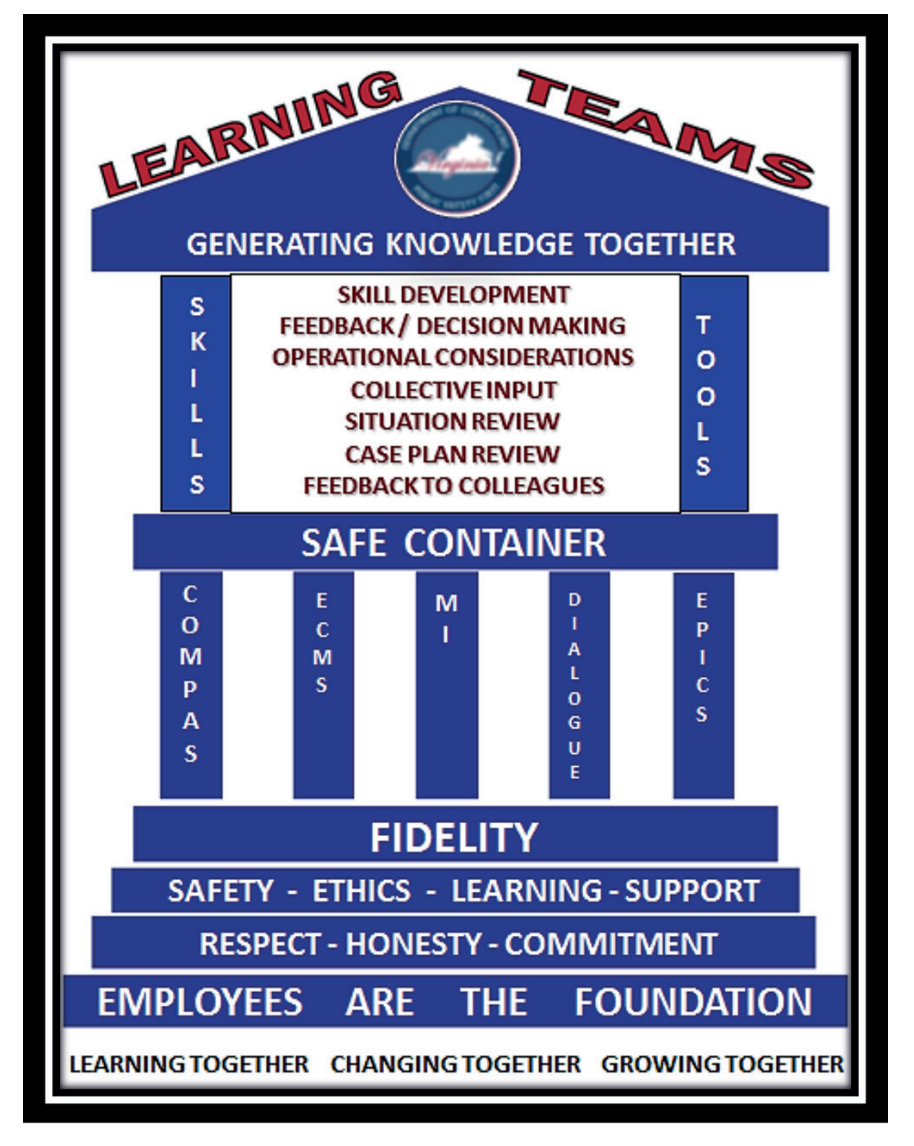
By the time Harold Clarke arrived in Virginia, its Department of Corrections had already begun work in moving toward a re-entry-focused agency through the Virginia Adult Re-Entry Initiative Strategic Plan. Many programs and projects were being piloted and introduced. Additionally, the VADOC aimed to be a learning organization and more effective agency through the use of evidence-based practices and programs, and the introduction of Learning Teams. (Learning Teams are small groups of employees that meet regularly to communicate, learn together, practice skills, grow professionally, and continually develop the organizational culture to better achieve its mission.) The Director realized the VADOC needed a vision and mission to pull the various initiatives and strategies together in a manner that could be understood by every employee, offender and stakeholder. Creating a Healing Environment was the perfect solution. The VADOC began to purposefully establish a culture where everyone – employees, offenders, and stakeholders – would be treated with dignity and respect; they would create together an organizational culture that would prioritize helping people be better through support and accountability. He realized that, more than ever before, the vehicle for the expression of the Healing Environment had to be Dialogue. Dialogue was the foundation that supported the cultural change. Dialogue has been key in aligning goals, breaking down silos, integrating separate pieces, and creating common expectations. Dialogue became the means of bringing people together to talk, think, and learn. Dialogue introduced a common language and specific skills which allowed people to engage with one another with less misunderstanding and increased participation amongst all levels of employees. Dialogue created the atmosphere where voices could be heard and new ideas could emerge.
Laying the Foundation
The introduction of Dialogue at the VADOC occurred in a top-down fashion. After discussing it with his Deputies, the Director introduced the topic through his reading list. All of the Executive Team members and Unit Heads (wardens, superintendents of facilities, and probation chiefs) received the book Dialogue and the Art of Thinking Together by William Isaacs. In it, Isaacs emphasizes the power of a Dialogue to open possibilities and see new options by speaking in a way that contributes one to the other.
Following the assignment of the reading, Dialogue Associates Founders Peter Garrett and Jane Ball were brought in to train the Executive Team members in some basic Dialogue skills. They began by looking at the history of the organization and having the leaders think about the culture of the Department at the time they began. David Robinson, the Chief of Corrections Operations, serving directly under the Director, viewed the session as an opportunity for growth. He observed that by reflecting on the history, and learning to think together, the agency would be propelled forward like an arrow from a bow. Following a period of transition and uncertainty, there would be growth, movement forward, and the rise of new leaders.
The first dialogic skills introduced were “check-ins” to learn how to get everyone in the meeting attentive, participating and focused. Executive Team members and Unit Heads were tasked with going back to their staff meetings and using check-ins and then come back together to reflect on the results. For those familiar with Dialogic skills, this will seem like a basic task. However, at the time, it was the first hint of a cultural shift. The VADOC culture did not value hearing everyone’s voice, and many meetings were held in a monologue fashion. In fact, many participants were so unaccustomed to speaking in meetings that they resisted participating in the check-ins initially. Deputy Director Cookie Scott recalled appreciating this change the most. She reflected that this was a different way of interacting; it provided the opportunity to sit within the Executive Team in a better way. The meetings were less directive and there was more conversation. The team members were able to learn about one another, hear one another’s authentic voices, and get a sense about not only what other people were thinking, but about who each individual was as a person and as a leader.
Meanwhile, Chris Innes was continuing with the Norval Morris Project and working on his book, Healing Corrections and Dialogue Associates was developing a plan to bring the Dialogue skills across the entire Department.
In 2012, Dialogue Associates began meeting with the Executive Team and Unit Heads on a quarterly basis. They taught them Dialogue skills for talking and thinking together and engaged them in thinking about and developing visions and initiatives for the Healing Environment in each of their Units. What would each institution, facility, probation office, and administrative department do to create a Healing Environment for their offenders and staff members? Greensville Correctional Center, for example, is the largest prison in Virginia and houses over 3,000 offenders. Greensville is the site of separate residential treatment programs, including mental health, medical, sex offender, and a veterans’ unit. Additionally, Greensville includes a work center and a death chamber. With there being so many different functions and employees at Greensville, they needed a Healing Environment Initiative to bring them together. Greensville felt like several different institutions, with different goals, each with distinct staffs, who happened to be working on the same 1000-acre compound. They were working in “silos” with limited communication or cooperation. They chose the motto “One Team, One Mission” as their Healing Environment Initiative. This made it clear to everyone that although Greensville was made up of a lot of components, they were all one team working towards the same goals.
Some Unit Heads struggled with the idea of working with their employees to develop Healing Environment Initiatives. They were still confused about the concept and not used to hearing the voices of their staff members when making decisions. However, over the course of the year, all of the Units managed to develop something that contributed to the Healing Environment. The impact was immediate in many areas. Employees had been allowed to contribute their thoughts and ideas to a major Department Initiative. Many were hopeful and enthusiastic about having been allowed to share their voice, and even more excited about the possibility of the Unit making the changes necessary to attain the Healing Environment goals. Many people expressed cautious optimism for the development of a respectful and supportive environment.
In 2012, Dialogue Associates also recognized the need to introduce Dialogue skills to all of the nearly 12,000 employees in the VADOC system. They began a Dialogue Practitioner Development Program (DPDP). The DPDP would start with the training of 24 individuals from across the Department to learn Dialogue Skills and then train and introduce these skills to others in the agency. I received an email saying I had been selected to be part of this group of trainers. I was excited to learn the new skills. I had heard the word Dialogue, but other than that had very little understanding what it was about. I also had been conducting many trainings around the Department and didn’t mind adding another one. Little did I know that Dialogue was going to be something completely different than what I had been doing and would ultimately change my world!
As our training as Dialogue Practitioners progressed over three days, our understanding of the concepts increased. We could see the value in the skills, especially the practices. We practiced with one another and learned how to deliver the Dialogue skills in the seven-hour standardized format of the Dialogue Skills Training. Despite understanding the importance of the subject, our ability to use the skills and our image of ourselves and our roles was limited. We believed ourselves to be “trainers” and focused on the definitions and explanations of the skills and, in some regards, more than their use. Along with my fellow 23 colleagues, we began systematically and enthusiastically training each and every person in the VADOC on the basic Dialogue Skills – with a focus on getting the trainings completed. Within a couple of months, many of the Dialogue Practitioners began to run into difficulties. Their supervisors did not want them being away from their positions for days or even weeks at a time, and they were finding it difficult to juggle their regular work with their Dialogue duties. Some Dialogue Practitioners were running into strong resistance at the Assistant Unit Head and Middle Manager levels. Nevertheless, the Director and his Deputies were not swayed from the goal. They continued to engage with the Unit Heads on the importance of the Dialogue skills.
The Dialogue Skills Trainings were conducted at every institution, facility and probation office; on average about 24 participants were taught at a time until all employees had taken the training. Additionally, the Dialogue Skills Training was incorporated into the Basic Skills Training for new officers and employees. The Dialogue Skills Training focuses on interaction through check-in/check-out and the modes of engagement. Awareness of the modes of engagement helps determine how the conversation will proceed; the right mode should be selected according to the goals of the conversation. If, for example, the purpose is to only convey brief information and not engage the participants in any exchange, then a monologue may be the correct mode. If the aim is to hear people’s thoughts and have input from different perspectives, then Dialogue would be the preferred mode. The training also emphasizes how to have functional conversations using the actions as well as quality conversations having the practices in place. The Dialogic practices of “Voice,” “Listen,” “Respect” and “Suspension” set the tone for quality conversations. Through these practices, an environment where people feel comfortable sharing and learning is developed. People feel safe to share their thoughts, and genuine exchange of ideas can happen.
The reaction to the Dialogue Skills Training was overwhelmingly positive, especially amongst the frontline employees. It was really the first time a concept was introduced that emphasized the value of their opinions or even the ability to provide their thoughts on a subject. As one Correctional Officer stated, “The Dialogue Skills Training explained that I am allowed to have a voice and my opinion should at least be respected even if it’s not the final decision.” The more often employees were exposed to the concepts, the more deeply established the skills became. Understanding was deepened in several ways. The initial introduction was accompanied by Dialogue posters that were placed in every Unit. There were separate posters for each skill set to help keep things simple. At a glance, a person could see the types of skills and a word that helped define each.
While the initial Dialogue Skills Trainings were being conducted, Peter Garrett began writing articles about Dialogue for the monthly newsletter that is electronically distributed to every employee. The articles explained the dialogic skills and principles in more depth than when introduced in the Dialogue Skills Training. They offered staff members the opportunity to read at their leisure and understand the larger purpose of the initiative. The first article was “What is Dialogue?” Here is an excerpt:
There are times when clear instructions need to be given in a command-and-control mode, particularly in times of crisis and with issues concerning security. There are other situations in which it is more helpful to think things through with others before reaching a decision, particularly when making changes that affect other people. The simple principle here is to include people who are affected by the change in the decision-making process, and this is where Dialogue is needed. In Dialogue people are encouraged to contribute their thoughts, experience and understanding in order to improve the quality of decisions.
–Peter Garrett, Around Corrections: Vol 1. Issue 3 – Feb. 2013
Another way in which the Dialogue skills were reinforced was through the Learning Teams. Learning Teams are small groups of 10-15 employees that meet regularly to communicate, learn together, grow professionally, and continually develop the organizational culture to better achieve its mission. At that time, Learning Teams were established within the Probation and Parole Districts, where they mainly focused on teaching the officers skills in motivational interviewing and effective communication with their probationers. A few of the institutions also had Learning Teams which focused on effective communication and case studies/scenario reviews. That is, within the Learning Team, the members would discuss a real-life situation that had occurred to examine what went well and what could or should have been done differently.
Learning Teams were scheduled to meet for an hour, twice a month. Those Learning Teams were efficient in teaching and practicing certain skills, including reflective listening, asking openended questions, using affirmation, and conducting “change talk.” However, those skills alone could not address a deeper level of effective communication, especially amongst colleagues. Dialogue holds the practices that set the climate, and changes the way people treat one another, respect one another. It opens their minds to new perspectives. Those are the added elements of more effective communication. It was imperative that all employees received these skills.
Dialogue Associates continued to work in separate sessions with the Executive Team, the Unit Heads, and Dialogue Practitioners on their development. Then they also began to work with selected staff members from those various groups to strengthen and expand the Learning Teams. The group developed a series of seven Dialogue Learning Plans. The purpose of the Learning Plans was to reinforce and practice the Dialogue skills within the Learning Team to support the use of Dialogue throughout the Department. More impressively, the group developed a comprehensive plan to systematically introduce Learning Teams across the Department in the Units that did not have them, develop and train facilitators known as Subject Matter Specialists (SMS), and conduct the Dialogue Learning Plans and assess the knowledge gained at the end of the seven Learning Plans.
The plan started with six pilot sites. Those sites were allowed to develop their own system for assigning employees to Learning Teams, scheduling Learning Teams, training their facilitators (SMSs), and conducting the Learning Plans. Some lessons could be completed in one session and other lessons needed two sessions to be completed, but it was at the discretion of the Units and the Specialists. After the pilot sites began, the workgroup continued to convene and examine which aspects were most effective and which were least effective, and to make recommendations and develop guidelines accordingly. The rest of the Department, with over 40 institutions and facilities and over 40 probation and parole offices, were incorporated into a 15-month Dialogue and Learning Team rollout with Units being brought in each quarter. Everyone in the Department was assigned – and new employees continue to be assigned – to Learning Teams. Revised Learning Team vision, mission, and policy were created. The Learning Team Model, a visual representation of the agency’s values, practices, initiatives, and purpose of the Learning Teams was created so that every employee would know that the VADOC is a learning organization and the Learning Teams are the mechanism to create and sustain a safe environment for staff to learn together in a way that fosters positive change and growth.
After the first year of training, it was clear that more Dialogue Practitioners would be needed to assist in getting the entire Department trained. An additional 60+ Dialogue Practitioners were brought into the Dialogue Practitioner Development Program (DPDP) while the first group of Dialogue Practitioners earned certificates as Dialogue Practitioner Trainers. Over the years, the DPDP has continued to grow as Dialogue Practitioner cohorts have been systematically brought in across the State and trained in the basic Dialogue skills at the same time as the more experienced Dialogue Practitioners, who have continued to grow in using their skills, gaining more knowledge about Dialogue and learning new skills. It was clear to the first cohort after the first year that they were more than trainers. They realized the impact of Dialogue and how they were change agents for the Department. Presently there are approximately 275 active Dialogue Practitioners in the Department. The Practitioners span across levels from Correctional and Probation Officers to Wardens, Probation Chiefs, and Regional Administrators. They come from diverse fields such as Education, Food Service, Medical, Agribusiness (agricultural operations), Environmental Services (chemical, industrial, and waste management), Research, Technology, Treatment, Security, and more. Every Unit has at least one Dialogue Practitioner and some larger Units have six or seven. We will continue to examine the activities of the Dialogue Practitioners and, later, the impact of their work.
Following the large wave of introducing and reinforcing the basic Dialogue skills through the Dialogue Skills Training, the introduction of Dialogue Learning Plans in the Learning Teams, and the articles written in the newsletter, the Department was ready for the next level of skills. Dialogue was not only a way to communicate and engage, but also a way of developing accountability. As Peter Garrett noted, Dialogue provides a forum to think through together the consequences of our collective actions and to shift our expectations of one another. It was time to move the Department from learning and talking about the skills into using the skills. This meant using the skills for better communication and quality interactions, and even more so to further the mission of the agency. It was especially incumbent upon the leaders in the Department to establish initiatives that serve a purpose and for employees to understand that purpose.
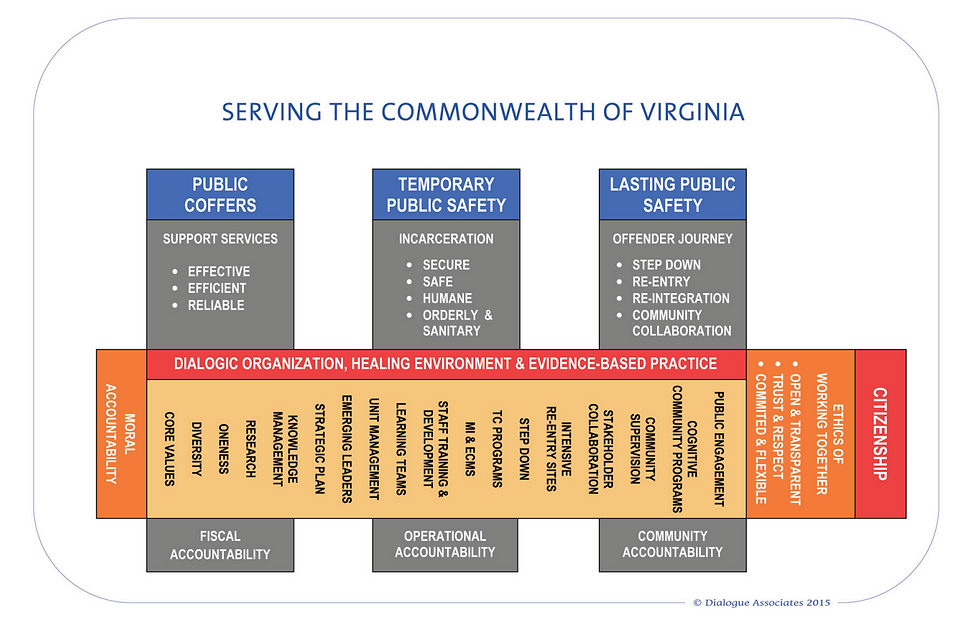
Thus, the idea of “Serving the Commonwealth of Virginia” was created. Dialogue Associates designed a poster which captured the essence of all of the activities of the Department and placed each of them into one of four categories. Every activity or decision of the Department should support at least one of these categories: Fiscal accountability, Operational accountability (incarceration), Community accountability (re-entry and probation), and Moral accountability (doing the right thing as well as the things that help individuals become better citizens). Over time and with new research and knowledge, the actual activities or initiatives may and should change, but the overall goal of reducing recidivism remains the same under the umbrella of serving the Commonwealth (Virginia is called a Commonwealth instead of a State as a largely symbolic term).
Just as it was important for employees to understand not only what they were expected to do but also why, it was also important for leaders to be accountable in how they lead. A good manager manages things and processes and meets the set requirements. A good leader leads people by the way he or she talks to and guides them to determine the way forward while accomplishing the tasks required. The VADOC had excellent managers. They had worked hard to develop safe and secure facilities. There was a very clear command-and-control structure in place. Yet even before Harold Clarke came to the Department, there was movement in developing the culture to be even better. It was certain that the leaders of the future would need to evolve. The next phase of Dialogue helped shape those nebulous ideas into structured, easy-to-understand principles. The Dialogue Coaching Training brought the concepts of Dialogue, accountability, coaching and leadership needs together in a seven-hour training. The idea of Dialogue and accountability was based on the premise that proactive support and challenge was more effective in shaping behavior than reactive disciplinary action.
The structure incorporates four levels of accountability actions: Dialogue, Coach, Hold to Account, and Discipline. The aim was for Unit Heads and supervisors to start building the foundation of the communication with Dialogue in their Units. Dialogue would be the mode for co-creating and taking ownership for ideas together, and for engaging with, supporting and challenging the day-to-day with each other. However, the coaching does not stop there. Supervisors needed to take the time to individually coach employees to improve their performance and support their individual development. Coaching is a matter of both support and challenge for actions, behaviors, and impacts. Even with coaching, sometimes people make mistakes, take shortcuts, or disobey directions and the supervisor has to respond. Even so, when the supervisor approaches the situation and engages the employee in a skillful conversation while using the Dialogue skills (e.g., listening with the intent to understand and respecting the person’s perspective, keeping an open mind, authentically voicing their expectations), the result is more likely to be favorable. And finally, discipline may be necessary when certain policies or laws are violated.
The Dialogue Practitioners were trained in the principles of coaching and then sent to facilitate the Dialogue Coaching Training with the management teams of each Unit as well as the Executive Team and the supervisors at headquarters. During the Dialogue Coaching Training, the supervisors had the opportunity to practice the skills of coaching an employee and holding an employee to account by doing role plays in groups of four. The groups consisted of one person playing the role of being the supervisor, one playing the role of the employee, one person supporting the supervisor and coaching him or her if her or she became stuck or veered off track, and the fourth as the bystander, providing observations of the entire role play at the end. Each training included several Dialogue Practitioners so that each small group could also have a Dialogue Practitioner sitting in. The Dialogue Practitioner for each group served as a facilitator keeping everyone in role, coaching and bystanding.
During every training session, inevitably there would be supervisors, oftentimes many, who would express dismay at the thought of doing role plays. Many were reluctant participants. However, afterwards participants offered overwhelmingly positive feedback and support for that aspect of the training. The supervisors were excited to learn and practice strategies to effectively support, encourage, and hold their employees accountable. Many participants even had “light bulb” moments when they realized their role in the problematic behavior, either through lack of coaching, unclear expectations, or other reasons. One sergeant expressed his epiphany as “I realize that I am contributing to the problem of our turnover. I do not get involved individually with the new hires. I tell them what they need to know and then I wait to see what they’re going to do. I do not make any investment in them until I know they’re going to stay. Now I see that I need to make an investment in them and that is what may help them transition better and remain employed with us. I am going to work on coaching someone every day.”
Another aspect of the Dialogue Coaching Training that helped the supervisors to think differently about coaching was the introduction of the Leading Energies. The Leading Energies give purposeful and productive direction to the coaching conversations. All of the Leading Energies are necessary for a successful outcome. Dialogue Associates defined the four Leading Energies as Visionary Energy, Performance Energy, Citizen Energy, and Wisdom Energy, and each has a distinct purpose. The Visionary Energy is thinking about the future. It is dreaming about what the future could hold and being able to see the big picture. Coaching with Visionary Energy asks questions such as “Where do you see yourself a year from now?” or “How do you envision your department?” Performance Energy is about getting the work done as expected. Performance Energy wants the numbers, data, and results. The positive use of the Performance Energy in coaching is setting targets and deadlines, checking in with the employee on the status of their progress or showing them how to track the data.
It only takes Visionary and Performance Energy to accomplish a task; set the direction (Visionary) and get it done (Performance). However, the other two Energies bring quality to the work. Citizen Energy involves being interested in the people, getting them participating, and making sure the right people are in the right positions, Citizen Energy coaching acknowledges the contributions of others, and provides them with the training or support needed for their success. Wisdom Energy brings perspective and reflection, as well as awareness, organization, and balance. The Wisdom Energy coach lives by the motto “Work smarter, not harder.”
The VADOC, as many organizations, had a tendency to overuse Performance Energy and underutilize the other Energies. There were many things to get accomplished and many priorities. Therefore, the majority of the supervisors tended to fall into Performance-based coaching. It was all about the numbers and meeting target expectations. With that being the case, when an individual wasn’t performing up to expectation, the supervisor naturally fell into reinforcing the targets and deadlines and using disciplinary actions if they were not met. The progression of the disciplinary process often consisted of a warning, a write-up, and then a disciplinary action. Supervisors who didn’t want to be overly punitive sometimes went too far in the other direction and made several verbal warnings but did not offer any other consequence or coaching. The structured nature of the coaching practice using the Leading Energies within the Dialogue Coaching Training offered supervisors new ways of thinking about interacting with their employees and approaching issues. Using the Dialogue skills also helped them think about what was behind the behavior. Was it a training issue? Did the person need more support and guidance? Did the person not understand the importance of the task in the big picture? Did the supervisor need to set the expectations more clearly and follow up? It was clear after the trainings that the majority of the supervisors began to think about their roles and approaches to coaching in a different manner.
The goal of teaching the Dialogue Practitioners about coaching was to help them as trainers and leaders become proactive and to help the leadership in the Department learn to be more proactive as well. The Dialogue Coaching Training was specifically designed to reinforce how supervisors talk to, engage with, support, and train employees to attract and retain quality people to accomplish the mission. Additionally, through coaching, employees are better able to make good decisions on their own and bring creativity and innovation to the workplace by sharing their ideas. These important qualities are not prominent in a command-and-control culture. The VADOC is seeing gains from becoming a coaching culture. Employees are being recognized for establishing innovative programs and practices. The Dialogue Coaching Training became a standard day of the Basic Skills for New Supervisors Training and remains so to this day.
Dialogue in Action
Most of the employees of the VADOC either embraced or accepted the use of the Dialogue skills as part of the way business is done in the Department. However, even though they were participating in Dialogues, there was a disconnect about how to obtain results from the Dialogues. People were not putting the ideas and information into practice. Some were becoming frustrated with the Dialogues, claiming that they were “all talk”; some made statements such as “They are good for hearing all of the voices, but they don’t get any real work done.” It was clear that people would need more guidance in conducting Dialogues that were meant to solve problems and make decisions. Thus, Peter Garrett and Jane Ball designed the Working Dialogue with input from a small but diverse working group. The Working Dialogue is a structured method that uses the skills within a Dialogue to explore opportunities, enhance processes, solve problems, or make decisions by including those affected by the change.
The Unit Head conducts the set-up with the Dialogue Practitioner who will be facilitating the Working Dialogue. They review the purpose and focus, who should be invited and the event details. Then they send out invitations to the participants. The actual Working Dialogue consists of three phases including a) current situation, b) desired outcome, and c) changes required to get from the current situation to the desired outcome. The current situation highlights what is presently happening regarding the situation. All of the participants share their thoughts and the DP facilitator notes them on a flip chart. By the end of the session, the DP will summarize the points reflecting the common understanding of the group. At the end of the session, there is a “gate” before moving to the desired outcome. The gate consists of questions to make sure all considerations have been made before progressing. The questions include 1) Has anyone been left out? 2) Have we heard everyone’s perspective? and 3) Do we have an agreed understanding? Each participant answers the questions on a scale from one to ten, giving the facilitator an opportunity to examine the issues further and possibly reconvene if key voices are missing or if there are scores below an eight. Alternately, they know they are clear to move forward if there is no issue.
The second phase of the Working Dialogue, the desired outcome, has the goal of thinking about new ways of working together to benefit the Department. The participants generate ideas of what they’d like to see happen or how things could ideally become. They tangibly describe what it would be like. The end of the session is then also closed by another set of gate questions. The third phase consists of looking at the changes required. The participants brainstorm as many different options as they can think of to achieve the desired outcome. Then they examine the risks and benefits of the options and make their selection. Once they have made their selections, they create an action plan detailing who in the room is responsible for doing what and by when. The session ends with another set of gate questions. The final aspect of the Working Dialogue is for the Unit Head and the DP to meet again to complete the follow-through by reviewing the process and the action plan to determine its effectiveness.
The response to the Working Dialogue was predominantly positive. As previously mentioned, a sizeable number of the employees of the VADOC are structured, performanceoriented individuals. Therefore, the structure of the Working Dialogue and the action plan, generated to monitor performance, fit with their personalities. They were able to see the tangible results of the Dialogue and felt a sense of accomplishment versus when they felt they were “wasting time” sitting in a regular Dialogue. All of the Units were charged with having at least two Working Dialogues going every quarter. This mandate was met with displeasure. Unit Heads who supported the process felt resentment at being forced to use it. It required the use of Visionary Energy to get them on board. They had to understand the big picture that new habits require practice to become ingrained. Any new process that isn’t reinforced will be lost.
It was also pointed out that the Dialogue Coaching Training was provided to the Management teams. Then the Management Teams were expected to take it back to their middle managers and first-line supervisors. Because it wasn’t required, only a few of the Units actually exposed all of their supervisors to the concepts. Then it had to be incorporated in the middle managers’ and supervisors’ annual training for a year to make sure that every supervisor had been introduced to the concepts. Furthermore, Management Teams did not use or reinforce the coaching and Leading Energy concepts amongst themselves and thus forgot some of the skills. Most Unit Heads accepted the rationale and attempted to use the Working Dialogue as a standard practice as much, if not more than, what was required.
At this time, Wisdom Energy has guided the Units in that they understand the Working Dialogue and it has become a business practice within the Department. They use it as needed and as appropriate. Several Units, especially Probation and Parole, are even using the Working Dialogue to address issues with external stakeholders and partners. However, this is not limited to Probation. Even institutions have used Working Dialogues with external agencies to accomplish joint ventures and goals. For example, one facility used a Working Dialogue with the Department of Transportation to plan how to use the offender roadcrew workforce in conjunction with the work to be done by the Department of Transportation. The results of the Working Dialogues have demonstrated a commitment by the staff for continuous improvement. People want to fulfill the mission of the Department and want their work to be meaningful. The future direction includes gathering the results of the Working Dialogues to share in a forum so that others can benefit by hearing ideas and information shared in other Unit Working Dialogues.
One of the most powerful interventions to affect systemic change is the Offender Resettlement Journey (ORJ). The experience an offender has from the time of arrest, through incarceration, then probation and until they are no longer supervised and out living as a productive citizen is their journey. To be resettled means to be successfully living in the community, free of involvement in the Criminal Justice System. A key event of the ORJ is to have one or more offenders recount their own personal journey in front of an audience of staff members, external stakeholders and partners and family members. They symbolically walk through their journey while answering questions from a facilitator. The DP facilitator asks questions about their experience, their emotions, and what helped or hindered them along the way. In this way, the audience connects to the person as a human being with feelings and an inside perspective. The audience gains insight into the pivotal moments, experiences, and conversations that impacted these peoples’ lives and how they can work better for the people who are still under their care or supervision.
Dialogue Associates partnered with the National Institute of Corrections to pilot three ORJs in 2014. Those events focused on a) specific aspects of re-entry issues from a highsecurity prison as well as re-entry issues for offenders who were difficult to program, as they were moved around institutions because of their misbehavior; b) offender re-entry into probation to eventual successful community living; and c) intake issues for offenders when they first enter into the VADOC. All of them were considered to be successful even though success was measured in different ways for each. What made them successful was that staff members and community stakeholders heard the stories and thought differently about their systems and what was working and what was not. They created lasting changes as a result of the events. For example, in one community, they restarted a Council comprised of various community stakeholders including VADOC, local law enforcement, Department of Social Services, Community Mental Health Treatment, and more to collectively address offender re-entry issues and work together on the most difficult cases requiring multiple points of intervention. In one of the institutions they realized that a lot of time was spent sending the personal property of the new intakes back to their homes. However, if they could communicate that to the jails before they brought the offenders, then the offenders could give the property directly to their families before leaving the jail and heading to prison.
In January 2018, Dialogue Associates returned to conduct four more ORJs with a focus on intensive re-entry and examining the slice of the offender journey between the last year of incarceration, which focuses almost exclusively on re-entry programming, and the first year of probation, which focuses on getting the offender settled into the community. Since the regions of Virginia are quite different from each other, sites were selected to represent those geographical areas as well as a women’s prison which serves offenders from across the Commonwealth. At the conclusion of each of those ORJs, the participants were placed into small groups to reflect upon the stories and generate topics or issues to be explored in more depth. Out of those groups, nearly 20 topics were brought up that needed to be examined. An ORJ Steering Committee determined that seven of those topics were universally applicable and should be examined from a statewide perspective. Working Dialogues were convened on the local level to address the site-specific topics. Working Dialogues also were convened with participants from across the Department for the seven universal topics. And as momentum works, those Working Dialogues prompted more issues to be addressed and more Working Dialogues, which are currently ongoing. For example, after a group discussed the need for enhanced peer support, increasing the use of external mental health peer supporters became a topic for a Working Dialogue. As a result of that Working Dialogue it was noted that peer support for substance abuse treatment is not substantially different from mental health peer support. Peer support is now recognized as a certified profession in Virginia. Therefore, a new group is working on developing the peer support requirements for certification of our offenders so they can have marketable skills upon discharge. This is just one example of the material benefits of the ORJ. There are many more tangible outcomes that improve the lives of the people under our custody and supervision.
Reaping the Benefits
There has been no other initiative that has penetrated through this organization at all levels as Dialogue has. Dialogue has taken root within the VADOC and has influenced every employee from every department as a true business practice that supports every other initiative. Dialogue has purpose and meaning for each employee, and has truly created an environment that encourages and enables each and every worker to know their role in working towards the mission.
Life in the Department has changed for all levels of employees. Everyone is encouraged to share their voice. Ideas and programs have been implemented because an employee – who may have previously kept quiet – was able to share their thoughts openly. Skillful conversations and Dialogues are happening at all levels, with people trying to gain common understanding and goals. By communicating more regularly and using Dialogue skills, people are more connected and willing to work together to resolve issues. There is a greater feeling of “oneness” that we are all in this together and have a shared vision towards which we are working.
Working Dialogues are happening every day across the VADOC to continually improve processes and procedures. The Department continues to be recognized as an outstanding leader and innovator in many different areas, including the response to the Prison Rape Elimination Act, reduced use of restrictive housing, Step-down (an incentive-based program for high-security inmates to progress within the system) and re-entry programming at maximum security prisons, Effective Practices in Community Supervision, Opioid addiction treatment, developing recycling centers (which have financially benefited the Department as well as produced marketable skills for offenders), focused mental health treatment while incarcerated and while on probation, and more.
All of the initiatives of the VADOC, beginning with the Healing Environment as the milieu and Dialogue as the mechanism, come together in service of the mission. The lead-in to the Strategic Plan quotes Director Harold Clarke: “We are in the business of helping
people to be better.” That is the mission condensed into one easy-to-understand sentence. And the Department must be doing something right. For the second year in a row, the VADOC has led the United States with the lowest recidivism level in the Nation at 22.4%, and it continues to decline. Other state agencies, Departments of Corrections from other states, and even other nations are looking to Virginia for guidance. The Secretary of Public Safety and Homeland Security for Virginia, Brian Moran, stated:
In 2011, under the leadership of Director Harold W. Clarke, the Virginia Department of Corrections initiated a multiyear transformation and has since undergone a wholesale culture change. The department consistently seeks opportunities to enhance existing practices. Now, other states and countries visit regularly to observe our practices and to understand how we have achieved success. The State Department has even partnered with the Virginia Department of Corrections to train other countries’ correctional leaders . . . Clarke has created a healing environment within the Virginia Department of Corrections by instilling a culture in staff and offenders alike that motivates them to create and foster positive and progressive changes. He operates from the principle that how we treat and engage offenders on the inside affects our communities on the outside; it affects the victims and their families, families of offenders and the men and women in our care, 92 percent of whom will one day be our neighbors.
– Brian J. Moran, Bristol Herald Courier via AP, June 15, 2018
However, as compelling as the story is from the Director, his supervisor and his employees, the most powerful testimony comes from the offenders under our care and supervision. A former offender who participated in the ORJs has formed his own business to help other formerly incarcerated individuals. He wrote an editorial to the paper about how the VADOC changed his life, excerpted below.
When I first arrived at DOC [Department of Corrections], I had no idea if I would make it out alive. With “life” hanging over my head, my incarceration started filled with darkness, despair, and hopelessness. This was during a time when the governor and director of DOC seemed to care nothing about our rehabilitation or our well-being, and there was no real access to programs.
Then in 2012, Gov. Bob McDonnell appointed Harold Clarke as the director of the DOC, and Director Clarke changed everything about my experience in the DOC. From that point, he emphasized that re-entry begins on day one and began implementing programs to help inmates to think differently and acquire employable skills.
I could immediately feel Mr. Clarke’s presence throughout the system, especially in the re-entry department. Even if an offender had not accomplished anything during his or her entire incarceration, there was now a director who said, “I’m still going to give them an opportunity to succeed in their last six to 12 months, and have a chance to make it in society.”
The re-entry program also helped inmates get D.M.V. identification cards, which can be difficult to obtain. This made renting an apartment or applying for jobs possible upon release. These seemingly simple tasks can be huge barriers for incarcerated people.
While incarcerated, I co-facilitated multiple treatment programs in re-entry, such as Thinking for a Change, Victim’s Impact, and numerous other programs. I can relay countless stories of success by the men who participated, including me. When I was released from prison, I felt over-qualified to re-join society. I was armed with pro-social concepts and definitions, and the tools necessary to succeed.
– Paul Taylor, “Preparing for Life after Prison in Virginia,” Richmond Times Dispatch, June 2, 2018
Vision of the Future
The VADOC journey with Dialogue continues. To review up to this point, Dialogue Skills Trainings are conducted for new employees and Dialogue Coaching Trainings are conducted in every new supervisor’s class. Dialogues are conducted on the different shifts to hear the voices of the correctional officers, during annual in-service trainings to have input from front-line officers, first-line supervisors, and middle managers, at monthly Unit Heads’ meetings for leadership to think and grow together, and across the Units. Dialogues have been conducted with visitors to better understand their concerns. Working Dialogues have become a business practice and are conducted internally as well as with external stakeholders. The skills have become part of the culture. There is still room for improvement in the culture change from command and control to direction and support as well as moving decision-making to the lowest possible level and making sure that all of the voices of the people who will be impacted by decisions are represented in the process.
Two developments currently in process include bringing offenders preparing for release (known as Returning Citizens) into the Dialogue fold and equipping them with the skills and knowledge of Dialogue in the final two years before their release. They will learn how to have more productive communication and better engagement. Over time, the skills could be introduced to the other offenders and even at intake so that they can have positive, quality conversations from the start. There are already instances of offender engagement in Dialogues with staff members, and teaching them the skills will only enhance those Dialogues. There is even potential for the “Elders” (higher functioning offenders charged with responsibility of encouraging, engaging, and guiding other offenders in the therapeutic program) to become Dialogue Practitioner trainers and coaches.
The other development is the evolution of the ORJ. The ORJ has been revised to reflect the goals of the VADOC. Now known as the Reentry, Reintegration and Reflection Experience (R3E), the enhanced purpose is discovering from the experiences, thoughts, and feelings of participants to reflect upon and learn current practices with the intent of gaining insight and understanding that will drive action for change, new areas of development, and overall improvement. The Department will continue to learn from the intensely personal experiences of the individuals under our care and supervision, and will delve deeper into areas in need of improvement.
References
Garrett, P. (2013). “What is Dialogue?” Around Corrections, publication of Virginia Department of Corrections. Vol. 1, Issue 3.
Innes, C. (2015). Healing Corrections: The Future of Imprisonment. Boston: Northeastern University Press.
Isaacs, W. (1999). Dialogue and the Art of Thinking Together: A Pioneering Approach to Communicating in Business and in Life. New York: Currency/Doubleday
© Harold Clarke & Susan Williams, 2020
The World Needs Dialogue!
Two: Setting the Bearings
ISBN: 978-1916191242